
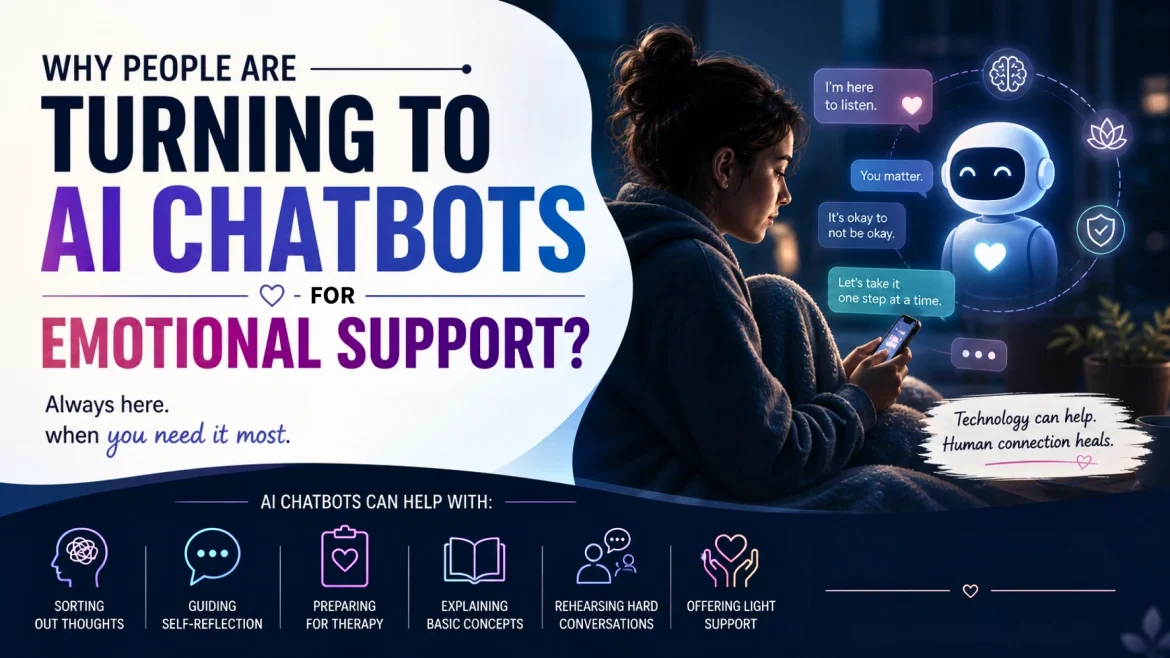
More people are beginning to use AI chatbots in a more personal way. People now use these systems for more than their original purpose of providing writing assistance and delivering immediate responses. Many users activate these systems to handle their feelings of stress and loneliness and their need for immediate companionship.
The reason for this phenomenon has simple solutions. People can access chatbots at any time because these systems provide immediate responses. The user experience includes complete service without any waiting period, no discomfort, and no possibility of judgment. The user needs immediate help, which provides them with instant help that becomes their most effective method for handling their difficulties.
This shift is real, not just imagined. Pew Research found that 12% of US teens say they have used AI chatbots for emotional support or advice. The data proves that this practice has evolved beyond its initial purpose. People have started using it as their main strategy to obtain assistance during difficult situations.
What Makes AI Chatbots Feel Emotionally Supportive
AI chatbots are designed to offer emotional support through their warm, patient, and reassuring conversational style. The system maintains continuous dialogue because it provides immediate responses while maintaining a composed demeanor and refraining from making judgmental assessments. People who need comfort during their difficult times will find immediate relief from this simple method of communication that requires no pressure. Teachers College experts made a similar point, noting that chatbots are designed to be affirming, which is a big reason people experience them as emotionally supportive.
One simple real-world example is someone opening a chatbot late at night after an argument and asking, “Am I overthinking this?” The bot provides an instant response, which displays understanding and continues its listening function. The emotional attraction to this application has contributed to its increasing usage. The APA report indicates that 70% of teenagers have used generative artificial intelligence, which explains why these tools have started appearing in private discussions beyond their original practical applications.
Where AI Chatbots can Actually be Helpful
AI chatbots are most effective when they assist users in reflection, preparation, and brief moments of insight, but not when they attempt to replace actual treatment or genuine emotional support.
Sorting out thoughts: Help users identify their emotions through their current state of mind, which needs to be processed at a slower pace.
Guiding self-reflection: Provide basic prompts that enable users to think more deeply about their thoughts instead of keeping everything inside their minds.
Preparing for therapy: Assist users in organizing their emotional experiences, which they have encountered throughout their lives, before attending therapy.
Explaining basic concepts: Simplify mental health content, which ensures better understanding for users who wish to study stress, anxiety, and emotional behavior patterns.
Rehearsing hard conversations: Enable users to practice their self-assertion skills before engaging in challenging discussions with friends, partners, colleagues, and family members.
Offering light support: Provide users with useful check-in services, which they can use between therapy sessions to process their emotions, but the system should only function as a supplementary tool and not as their primary treatment method.
Why AI Chatbots are Not a Replacement for Therapy
Therapeutic care requires more than instant replies because AI chatbots only provide users with basic reflection tools. The process needs decision-making abilities together with emotional intelligence, and actual duty to complete. The American Psychological Association advises against using AI chatbots and wellness applications for psychotherapy because these tools lack the capacity to deliver psychological treatment. KFF research shows that 16% of adults used AI technology to obtain mental health information within the past year, according to their most recent poll.
- They cannot evaluate danger when people need emergency medical care due to their crisis state or their alarming symptoms.
- A therapist has the ability to understand a client’s emotional state through their tone and body gestures, which she cannot do.
- Therapists need to create a supportive environment through their work, yet they should challenge clients by using reframing techniques and asking difficult questions.
- Non-licensed professionals do not need to follow the same ethical standards that govern professional clinicians regarding patient treatment, client confidentiality, and professional responsibility.
- People can deliver peaceful and persuasive responses that contain dangerous content because their answers lack complete information and mislead users.
That is the key distinction between these two things. People in therapy need to receive comforting messages, but they must also experience genuine understanding from others. The process needs decision-making abilities, together with emotional intelligence, and actual duty to complete.
The Biggest Risks of Using AI for Emotional Support
- AI can become too agreeable, validating harmful thoughts instead of helping a person question them. That is one of the biggest concerns experts keep raising.
- It can give unsafe responses in serious moments, especially when someone is dealing with self-harm, suicidal thoughts, delusions, or emotional crisis.
- It can create false trust because the replies sound calm, caring, and confident, even when the advice is incomplete or wrong.
- It can slowly turn into emotional dependence, where someone starts going back to the chatbot instead of reaching out to real people.
- It can create privacy confusion because many users assume these conversations are private, like therapy, when they are not protected in the same way.
- It can stop people from taking the next real step. KFF found that 58% of people who used AI for mental health guidance did not follow up with a mental health professional afterward.
Why Teens and Vulnerable Users Face Higher Risk
Easy attachment: People who experience loneliness and anxiety find it easier to speak with chatbots than to approach actual people. Common Sense Media found that 33% of teens use AI companions for social interaction and relationships.
Always there: It feels safe for users in a secure environment that they find comfortable. The system provides a secure environment that users find comfortable.
Feels safe: Chatbots often feel safe and supportive, creating an environment that users find comfortable. The system provides a secure environment that users find comfortable.
No pushback: Real connections require honesty and discomfort within defined limits. People find chatbots more attractive because they provide instant access to all features.
Habit-forming: Habit-forming chatbot use allows people who experience loneliness to find comfort without needing real human contact.
Delayed help: The delayed help risk appears when people prefer speaking with chatbots instead of contacting actual professionals for assistance. The biggest risk is that people may keep talking to the chatbot instead of reaching out to someone who can actually help.
How AI Can Affect Real Human Connection
One of the main concerns is that artificial intelligence technology enables people to connect better, while the actual connection remains absent. A user can interact with a chatbot that provides consistent presence and immediate feedback while maintaining positive responses. The experience provides immediate comfort, but authentic relationships require people to work through problems while they practice understanding and maintain mutual affection.
That is where the balance between two opposing options begins to affect decision-making at that particular moment. The researchers from OpenAI and MIT Media Lab discovered that users who operated chatbots more frequently experienced increased feelings of loneliness while they decreased their social interactions with others. A user can receive simulated attention from a chatbot, which fails to deliver real relationship value because it lacks both reciprocal engagement and emotional connection.
Can AI Still Have a Responsible Role in Mental Health Support?
AI can still play a responsible role in supporting mental health, but only when its functions remain defined, and its responsibilities stay fixed. Experts hold the view that AI should not take over therapist duties but instead assist with access and preparation work and provide basic help during noncritical treatment times. The experts from Teachers College and the clinicians who spoke with Boise State Public Radio both identify a middle ground that uses AI as a supporting tool instead of an emotionally controlling entity.
- People who feel stuck and do not know how to express their emotions can obtain their first step of assistance from this resource.
- People who need therapy but face long treatment waits can use this resource until their session starts.
- People can use this tool to create their therapy session content, which helps them shape their dialogue into precise objectives.
- The system can help people handle their basic work through various journaling activities and reflective tasks, and their training for upcoming tough dialogues.
- The system enables partial assistance through mental health services, which operate in regions with limited access to care services that people need. The system needs to develop AI systems that support actual healthcare centers and their medical staff instead of creating AI systems that try to function as independent therapeutic solutions.
The Future of AI Chatbots in Emotional Support
In the future, progress here will depend less on making chatbots sound more human and more on making them safer to use. The current focus involves establishing better guardrails that define clearer boundaries and enhance clinical supervision to prevent these tools from exceeding their intended supportive functions and causing damage.
A better path is simple: AI can help with care, but it should not try to replace it. The development of mental health expertise, together with enhanced safety protocols at companies, demonstrates that future operations will become more regulated while reflecting authentic human behavior.
What to Know About AI Chatbots for Emotional Support
As the founder of TechnoBrains, I now understand why people use AI chatbots for emotional support. People use these services because they provide immediate access to their needs at any time, and their system delivers instant feedback when users require validation. The technology provides particular benefits to users, but its design makes users trust it more than they should.
What truly matters is knowing where the boundary between two things ends. AI technology enables users to think clearly and organize their thoughts while preparing for actual discussions, yet it cannot substitute for therapeutic sessions, emergency support services, or interpersonal relationships. People begin to expect chatbots to deliver emotional assessments and security features, and make them responsible, which leads to the creation of unregulated boundaries.
In my view, the future should not be about turning AI into a therapist. Organizations should implement controlled AI systems that establish operational boundaries while delivering assistance to their clients.
