
Most companies treat AI like a new idea. Amazon is treating it like the destination it has been heading toward for the last two decades. When AWS launched in March 2006, it was a books company telling businesses it wanted to handle their computing infrastructure. Nobody understood it. Jeff Bezos embraced the confusion and called it part of the plan.
That same story is playing out again today, just with a lot more zeros attached. AWS recorded $35.6B in revenue in Q4 2025, a 24% year on year increase and its strongest growth rate in 13 quarters. That kind of momentum does not come from a company that just discovered AI. It comes from 20 years of quietly building the infrastructure that AI actually needs to run.
After more than a decade in AI implementation, I have seen companies treat AI like a product launch. Amazon is treating it like plumbing. And if history is any guide, the companies that build the plumbing tend to win the longest.
What is AWS, and why has it become the Internet’s Backbone
Most people interact with Amazon AWS every single day without ever knowing it. Every time you stream Netflix, book an Airbnb, or track a delivery, AWS is quietly running the infrastructure behind it. It is not a product you see. It is the foundation that everything else runs on.
When AWS launched in March 2006, the pitch was genuinely radical. Amazon would handle all the backend infrastructure so that businesses could focus entirely on building their products. No servers to buy, no data centers to manage, no IT team on call at 3 am. For a company the world knew as an online bookstore, it was a move nobody expected, and most people doubted.
That doubt did not last long. Two decades later, AWS powers some of the most critical infrastructure on the planet. The NFL, NASA, the SEC, and thousands of Fortune 500 companies all run on it. When AWS goes down, parts of the internet go with it. That is not an exaggeration. That is literally what happens.
In Q2 2025, global cloud infrastructure spending grew by over $20B, a 25% jump year over year, bringing total quarterly spending to $99B, according to Synergy Research Group. That market exists largely because AWS created the category. And the same instinct that built the cloud is now driving Amazon’s AI infrastructure bet. Same playbook. Much bigger scale.
Why it matters for businesses today:
- AWS serves customers across 245 countries and territories.
- Over 100,000 companies now build on Amazon Bedrock alone.
- More than 65% startups are building on AWS infrastructure.
The $200 Billion Question: Where is Amazon’s Money Actually Going?
Over 60% of the $200B is dedicated specifically to AWS infrastructure, including the rapid deployment of Amazon’s custom Trainium3 and Trainium4 chips, aimed at reducing reliance on external hardware providers and lowering the long-term cost of AI training.
Here is where the money is actually going:
- Purpose-built AI Factories designed for liquid cooling and trillion-parameter models
- Custom Trainium and Graviton chips now generating over $10 billion in annual revenue
- Amazon Bedrock expansion supporting 100,000-plus companies building AI apps
- Project Kuiper satellite infrastructure for global AI connectivity
- A record $53 billion bond issuance in March 2026, just to fund the rollout
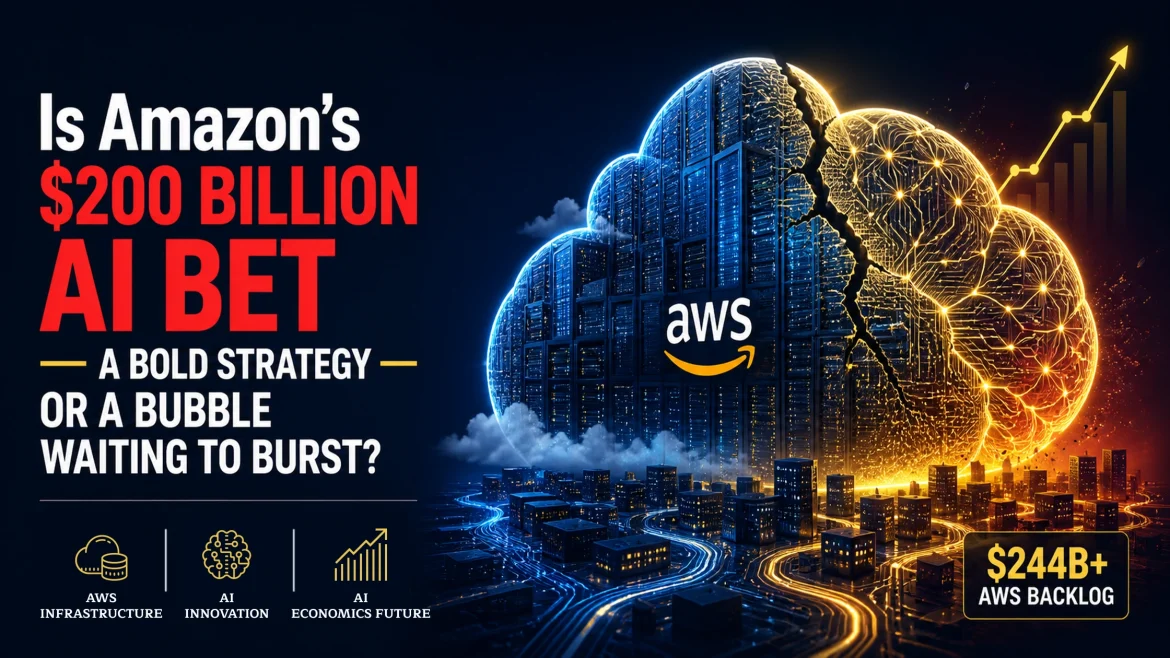
The real signal here is not the spending number. It is the $244B AWS backlog sitting behind it. That does not happen unless the demand is already there.
Amazon Bedrock and the Real AI Play: Making AI Accessible to Every Business
- One API, nearly 100 models from Anthropic, OpenAI, Meta, Google, Mistral, and more, no vendor juggling required.
- AgentCore SDK has been downloaded over 2 million times in just 5 months, and developers are not just exploring it; they are shipping with it.
- Stateful Runtime Environment built with OpenAI so AI agents remember context across sessions instead of resetting every time.
- Nova Forge SDK for domain-specific model customization without needing an ML engineer in the room.
- Built-in Guardrails filter harmful content across 100-plus categories, exactly what regulated industries need before they can move forward.
- Full compliance out of the box, including SOC 1, 2, 3, ISO 27001, PCI DSS, and FedRAMP High.
- OpenAI-compatible API endpoints, meaning teams already building on OpenAI can plug into Bedrock without rewriting a single line of code.
The Cloud War is Not Over: How Microsoft and Google are Closing the Gap
Amazon still leads. But the gap is shrinking, and both Microsoft and Google know exactly where to push.
AWS holds approximately 31% cloud market share with $110B plus in annual revenue, while Azure is rapidly closing at around 25% share, powered by enterprise Microsoft relationships and AI workloads. Here is how each player is actually positioned right now:
AWS is the infrastructure default. 250 plus services, the widest model selection through Bedrock, and the deepest startup ecosystem. If you want flexibility at scale, nothing else comes close.
Azure is winning on stickiness. Every Fortune 500 company already has a Microsoft Enterprise Agreement for Windows and Office. Azure credits get bundled straight into those deals. Add the exclusive OpenAI partnership, and enterprise teams rarely even shop around.
Google Cloud is the fastest grower. GCP’s Q4 2025 revenue hit $17.7B, up 48% year over year, giving it a $71B annual run rate heading into 2026. It wins on AI native tooling, Vertex AI, BigQuery, and Gemini integration, especially for data-heavy teams.
From my experience in AI implementation, the cloud decision stopped being about price a long time ago. It is now about which platform makes your AI ambitions easier to execute without creating a dependency you regret in three years. That is the real question every business needs to answer before they pick a provider.
Amazon’s Layoffs and AI: What the Company is Not Telling Us
Amazon cut roughly 30,000 jobs across two rounds in October 2025 and January 2026. The official line was to reduce bureaucracy and flatten management layers. But Andy Jassy had already told employees publicly that as AI agents roll out across the company, Amazon will need fewer people doing certain jobs. The tech industry reported 33,330 layoffs in just the first two months of 2026, a 51% increase from the same period last year, with AI cited as a factor in over 12,000 of those cuts.
The harder truth is that spending $200 billion on AI infrastructure while cutting 30,000 jobs tells its own story. Projects that once took two to three years and large teams are now being completed in months with small groups. That is good for the business. Whether it is good for the people on the other side of that efficiency gain is a different conversation entirely.
Is There an AI Bubble? The Question Wall Street Can’t Stop Asking
Big Tech collectively lost $1.35 trillion in market value in a single week after earnings revealed their $660B AI spending plans for 2026, with Amazon leading the selloff after its stock dropped 11% overnight.
The case that it is a bubble:
- Amazon’s free cash flow fell from $32.9 to $7.7 billion as capex consumed 94.5% of operating cash flow
- D.A. Davidson downgraded Amazon stock, citing AWS losing its lead and scrambling to catch up through escalating spending
- CFO Brian Olsavsky offered zero payback timeline, only saying Amazon sees a “long, strong return on invested capital.”
The case that it is not:
- AWS demand is currently outpacing available capacity; the infrastructure is needed before it is even finished
- Citi and JPMorgan both raised Amazon price targets to $285 on March 25, 2026, projecting AWS growth accelerating to 37% by 2027
- 90% of the 150 senior technology leaders Garman met with said they were seeing or expecting solidly positive ROI within six months
Every major infrastructure cycle in tech looked like a bubble until it did not. The pattern is always the same. The real question is not whether the bubble exists. It is whether Amazon is building for where demand is actually heading.
What Amazon’s AI Bet Actually Means for Businesses Building Today
If you are a startup, Google Cloud gives you more generous credits and an easier onboarding experience. But over 65% of billion-dollar startups are building on AWS. The ecosystem depth matters more as you scale.
If you are an enterprise, the platform decision you make in 2026 is the one your teams will be optimizing around in 2030. Azure wins on Microsoft stickiness. AWS wins on flexibility and model choice. Pick based on where your stack already lives.
If you are a developer, Bedrock, SageMaker, and Amazon Q Developer have genuinely collapsed the gap between idea and production. The tools are there. The only question is whether you are using them.
From my experience in AI implementation, the businesses that fall behind are never the ones that picked the wrong model. They are the ones who waited too long to commit to any infrastructure at all. Amazon spent 20 years building this foundation. You do not have 20 years to decide whether to use it.
The Real Test Ahead: Can Amazon Deliver on its Biggest Bet Yet?
On paper, Amazon has everything it needs: infrastructure, platform strength, capital, and a $244B backlog that shows real demand. But analysts noted in January 2026 that while AWS’s AI capabilities are now credible, its go-to-market execution and capacity planning are still catching up.
The real risk is not the strategy. It is execution. Internal reports showed 69 to 81% regretted attrition at AWS, meaning experienced engineers are leaving. The October 2025 us-east-1 outage also raised concerns, taking longer than expected to diagnose. That kind of operational knowledge is not easy to replace.
As the founder of TechnoBrains Business Solutions, I have spent over a decade helping companies implement AI at scale, and the pattern is always the same. Strategy is rarely the problem. Execution is. Amazon has a 20-year track record of making bets nobody believed in and becoming indispensable anyway. This $200B bet comes from that same instinct, just at a very different scale. Whether history repeats itself depends on whether the people and culture can keep up with the ambition. That is the only question that really matters now.
