
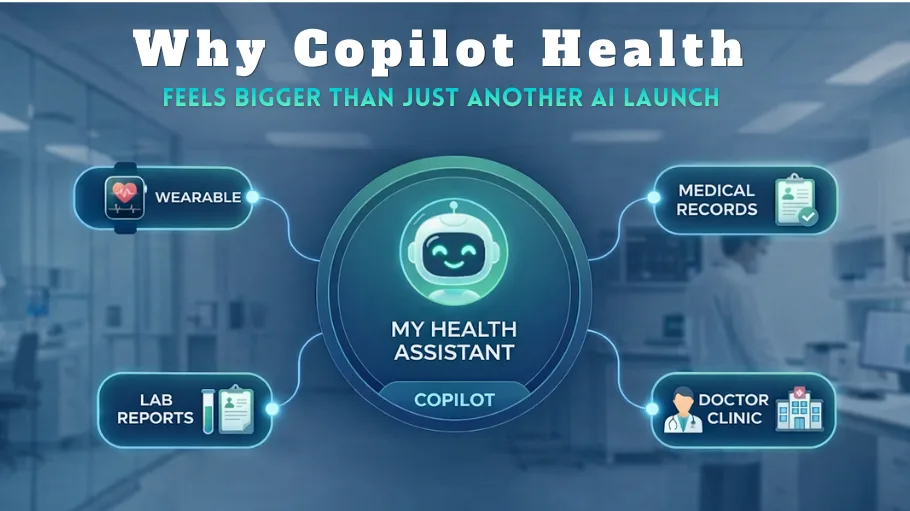
The launch of Copilot Health is worth paying attention to because its operational changes create new opportunities for assessment. People increasingly use AI tools to help them determine their medical conditions, understand their laboratory results, and choose their medical treatment before visiting a medical facility. Microsoft is not creating that behavior from scratch. The company is developing its solutions based on established customer needs that already exist in the marketplace.
The scale of that demand is what makes this moment important. Microsoft says its consumer products already handle more than 50 million health questions a day, which suggests health is no longer a secondary use case for AI. It is becoming one of the most practical and frequent reasons people open these systems in the first place.
That is why Copilot Health feels bigger than a simple feature release. The real opportunity here is not to give people more information, but to help them connect records, wearables, test results, and care decisions in a way that actually feels useful. From where I see it, this launch matters because it signals where consumer health AI is heading next: toward more context, more continuity, and a much bigger role in everyday care journeys.
What is Microsoft Copilot Health, and How does it Help Consumers?
At a product level, Copilot Health is Microsoft’s attempt to make personal health information easier to use. Instead of behaving like a general chatbot, it creates a dedicated health space where users can connect medical records, wearable data, lab results, and provider search in one place. That matters because for most people, the problem is not a lack of health information. It is the effort of trying to piece everything together on their own.
Microsoft’s research found that nearly 1 in 5 health-related Copilot conversations involve people asking about their own symptoms, test results, or conditions, which shows how real this demand already is.
- The platform creates a unified medical record system that combines clinical records with wearable device data and laboratory test results instead of requiring users to access multiple applications and online platforms.
- The platform presents visit summaries, medication information, test results, and overall health trends in language that makes it easier for users to comprehend the content.
- It makes doctor visits more productive by helping people organize context and prepare better questions before an appointment.
- It also supports provider search by helping users look for doctors based on specialty, location, language, and accepted insurance.
What I find most important here is that Microsoft is not positioning Copilot Health as a diagnosis tool. It is positioning it as a support layer that helps people interpret, prepare, and navigate. That is a much more practical place to start. In consumer health AI, the products that will matter most are the ones that reduce confusion and help people take the next step with more clarity.
How Microsoft Copilot Health Connects Health Records, Wearables, and Lab Data
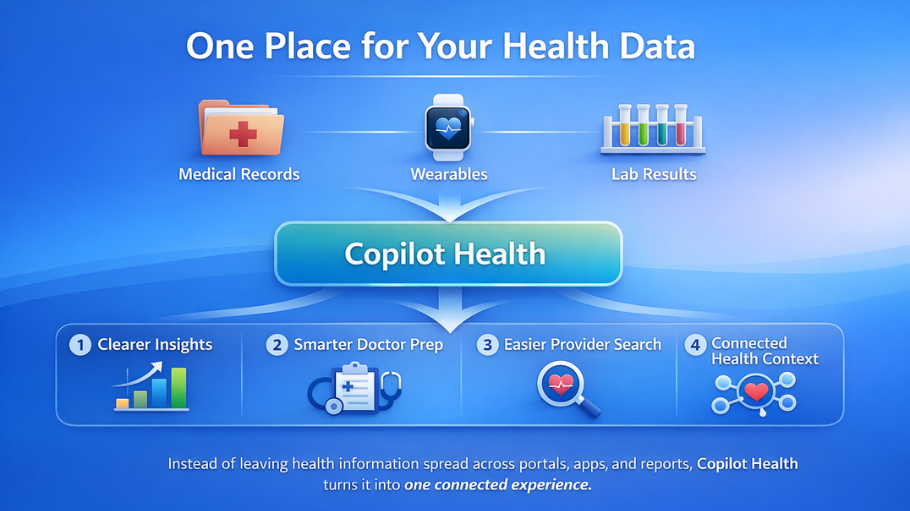
One reason Copilot Health stands out is that it is not built around a single data source. It is trying to combine the pieces people already use across their health journey and make them feel connected. That matters because consumers are already comfortable generating health data in different places. PwC’s consumer survey found that 70% of consumers use AI healthcare apps or wearable technologies, which tells me the raw data is already there.
The real gap is that it still lives in separate systems, with very little context tying it together. Medical records can be pulled in from hospitals and provider organizations through HealthEx, including visit summaries, medication lists, and test results.
- Wearable data from devices like Apple Health, Oura, and Fitbit adds day-to-day signals such as activity, sleep, and vitals that traditional records usually miss.
- Lab results from partners like Function bring another layer of detail, which helps move the experience beyond general wellness tracking.
- Once those sources are combined, Copilot Health can look for patterns across them instead of treating each source like a separate story.
Why Better Context Leads to Better Health Decisions
In healthcare, context can change everything. A symptom on its own rarely means much. Sleep data without medication history is incomplete, and lab results without recent visits can be easy to misread. The design of Copilot Health uses connected information, which becomes necessary for complete system operation. A 2026 survey found that 62% of healthcare leaders still see fragmented data systems as a major barrier to AI maturity, which shows how common this problem still is today.
That is also what makes this useful for consumers. Better health decisions do not come from getting more information. They come from seeing the right information in the right context. By bringing records, wearables, and lab data into one view, Copilot Health has a better chance of helping users understand what matters and what is worth discussing with a doctor.
Why AI is Becoming the First Stop for Everyday Health Questions
Health intent patterns in Copilot shift across the day, with symptom-related and emotional well-being queries rising later in the evening and at night.
- What feels most revealing to me in our time today is the moment when people decide to ask health questions about their medical problems to artificial intelligence. The time when daytime hours end shows when people need to talk about their personal matters because they require fast answers to their problems.
- Microsoft’s 2026 research shows that emotional well-being queries rise by more than 50% at nighttime compared with the morning. That is a strong sign that people are already turning to AI in the hours when support feels less accessible, and concerns start to feel bigger.
- Symptom-related questions also climb later in the day, and honestly, that feels very real. A small health concern often becomes more pressing at night, especially when there is no easy way to speak to someone right away.
- This is exactly where a product like Copilot Health starts to make sense. It fits into those in-between moments when someone wants to understand what might be going on before deciding what to do next.
- I do not see this as AI replacing clinical care. I see it as becoming the first layer of support before the appointment, between appointments, or during the hours when the healthcare system feels out of reach.
- That is the bigger shift this chart helps show. For a growing number of users, the first stop for everyday health questions is starting to become an AI interface that feels immediate, conversational, and always available.
How Microsoft Copilot Health Can Improve the Patient Experience
The biggest opportunity for Copilot Health is not just answering health questions. It is making the overall patient experience feel less scattered and less frustrating. A lot of people are not struggling because they lack information. They are struggling because too much of it lives in different places, shows up without context, or becomes hard to use when it actually matters.
Record Access
It can make health information easier to pull together, so users are not stuck jumping between portals just to understand their own history.
Visit Prep
Using this service helps people arrive at their appointments with improved contextual understanding, enhanced questioning skills, and precise identification of essential issues to tackle.
Provider Search
This system allows users to find their desired doctor by searching through doctor data, which includes information about medical specialties, office locations, spoken languages, and accepted insurance plans.
Care Navigation
It can support the in-between moments when people are unsure where to go, what to ask, or whether something needs follow-up.
Daily Clarity
It can turn scattered records, wearable signals, and lab data into something more understandable, which is where a lot of real user value starts.
Why Personalized Health Insights Matter in Consumer Healthcare
Generic health answers can be useful for simple questions, but they fall short the moment a person needs advice that reflects their own history, habits, or current condition. That is the gap Copilot Health is trying to close. Microsoft’s recent health usage analysis found that 9% of health queries are already about personalized lifestyle and fitness coaching, which shows people are not just looking for information anymore. They want guidance that feels specific to them.
That is why personalization matters more than generic answers in health AI. A lab result means more when it is viewed alongside sleep trends, medications, and past visits. A symptom feels more actionable when it is interpreted with real context instead of broad internet-style advice. From my perspective, that is where tools like Copilot Health become more useful than a standard chatbot. They are trying to move from answering questions to helping users understand what those answers mean in their own lives.
Also read, Before AI Can Help, Let’s Heal the Heart of Healthcare First.
How Microsoft is Framing Privacy, Safety, and Control
For a product like Copilot Health, privacy and safety are not side features. They are the whole foundation. The moment a company asks users to connect medical records, wearable data, and lab results, the real question becomes simple: can people trust the system enough to use it consistently? Microsoft seems to understand that, which is why a big part of the launch is centered around separation, control, and clear limits.
- A separate health space: Copilot Health is being positioned as a dedicated environment, separate from general Copilot, so health conversations do not feel mixed into a broader AI experience.
- No training use: Microsoft says information shared in Copilot Health is not used for model training, which is one of the first things users will want to know before uploading anything sensitive.
- User control: People can disconnect health data sources, manage what is connected, and delete information when they choose. That kind of control matters because trust usually depends on how easy it is to step back out.
- Clinical oversight: Microsoft says the product has been informed by an external panel of more than 230 physicians across 24+ countries, which helps reinforce that the safety story is not being framed as a pure engineering exercise.
- Governance signals: The company is relying on encryption plus strict access controls, together with ISO 42001 certification, as security measures to demonstrate that its project development follows formal governance protocols instead of focusing on creating a consumer-friendly image.
The Trust Gap in Consumer Health AI Still Hasn’t Gone Away
A new study from the University of Oxford adds to that concern. Participants who used AI chatbots for medical advice were able to identify their medical condition correctly only one-third of the time, which demonstrates that consumer health AI systems still have operational limitations when people use them to understand their health conditions or make decisions about their subsequent actions. The tools maintain their value, yet the statement demonstrates that organizations need to establish customer trust in these products through a methodical development process.
The challenge is not only accuracy. It is also an expectation. Copilot Health is being positioned as secure and helpful, but it still stops short of being a clinical system. That creates a gap between what users may assume the product can do and what it is actually designed to handle. In my view, that gap is where the biggest trust challenge still sits.
Why Medical Guidance Without Clinical Liability is Still a Challenge for Health AI
- This is where consumer health AI gets tricky. The product needs to feel useful enough to guide people, but not so clinical that it crosses into diagnosis or treatment.
- Copilot Health is clearly walking that line. It offers personalized health insights and next-step support, while still saying it is not a substitute for professional medical advice.
- That balance matters because the moment a tool starts sounding too definitive, user expectations change. People stop treating it like support and start treating it like medical judgment.
- The regulatory backdrop makes this even more important. A 2026 legal analysis of FDA guidance notes that liability for product malfunctions or misinterpretation of results remains a key issue, even when a product may not need a formal FDA pathway.
- From where I see it, this is why wording, safeguards, and boundaries matter so much in health AI. The product has to be helpful without sounding overconfident, and supportive without implying clinical certainty.
How Copilot Health Compares With ChatGPT Health and Amazon Health AI
What stands out to me is that all three are chasing the same opportunity: becoming the first place people turn to for health-related support. Microsoft is positioning Copilot Health around connected context by bringing together records, wearables, lab data, and provider search in one separate health space. OpenAI is pushing a similar consumer health model through ChatGPT Health, while Amazon is tying its health AI more closely to care access and follow-through.
Where they start to differ is in positioning. Microsoft feels more focused on helping users organize context and prepare for care, OpenAI is leaning into the scale of consumer health usage, and Amazon is pushing closer to care access and follow-through. OpenAI says more than 230 million people ask ChatGPT health and wellness questions each week, which shows how quickly this space is moving. To me, that makes this less about who launched a feature first and more about who can make health AI feel the most useful and the most trustworthy over time.
What Microsoft Copilot Health Signals for the Future of Consumer Healthcare
What makes Copilot Health feel important is that it points to where consumer health AI is heading next. This is no longer just about asking a chatbot a health question and getting a quick reply. It is about building a more connected layer that can bring together records, wearables, lab data, and care navigation in one place. Microsoft’s bigger “medical superintelligence” framing only makes that direction clearer.
The market is moving away from generic health prompts and toward more structured, more personalized, and more controlled experiences. As a founder at TechnoBrains, I see the opportunity very clearly here. The products that will lead this space will not be the ones that simply sound intelligent. They will be the ones who make health decisions easier to understand, easier to trust, and easier to act on in the real world.
If you’re exploring how AI is shaping real-world systems like healthcare, you can connect with me here to discuss ideas, use cases, or practical implementation approaches.
