
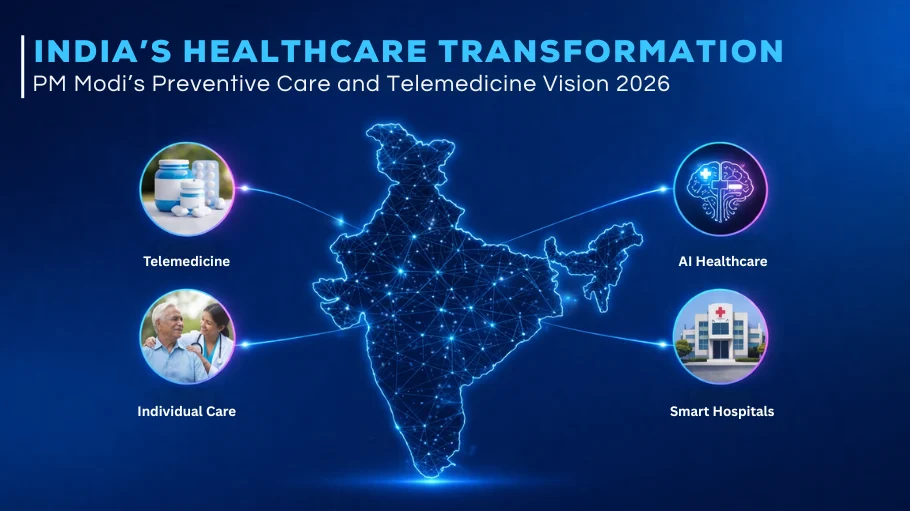
When PM Modi spoke about preventive and holistic healthcare at the post-Budget webinar on “Sabka Saath, Sabka Vikas: Fulfilling Aspirations of People,” it felt like a bigger signal than a regular policy update. What came through clearly was this: India’s healthcare future cannot rely on treatment alone. It also has to be built around early care, better access, and stronger systems.
What I find most interesting is how these elements are now being discussed together. The fields of telemedicine and preventive care, together with workforce training and caregiver demand, have become one continuous dialogue. The current changes in Indian healthcare systems show the development of a unified transformation process.
The Ministry of Health and Family Welfare received ₹1,06,530.42 crore from the Union Budget 2026–27, which demonstrates that the government treats healthcare funding as a critical national priority. The discussion has expanded to include more actual applications, which demonstrate future possibilities, according to me.
Why Preventive Healthcare is Becoming Central to India’s Health Strategy
When Prime Minister Modi spoke about preventive and holistic healthcare practices, he established a new paradigm for Indian health discussions. The current emphasis of the research seeks to study health conditions before they develop into diseases. The main objective now requires organizations to identify health threats at an earlier stage while they work to enhance people’s daily health and create a system that treats minor medical problems before they escalate into serious conditions.
What makes this shift important:
- It reduces pressure on hospitals by strengthening care at the first level.
- It brings healthcare closer to communities instead of keeping care dependent on larger city-based facilities.
- It makes the system more practical because early care is usually easier and less costly than delayed treatment. This is an inference based on the government’s focus on wellness, early diagnosis, and primary care expansion.
- It also creates a stronger base for digital health and AI-led delivery later, because prevention works best when care is consistent and easier to track. This is my interpretation of how preventive care and digital systems fit together.
You can already see that push on the ground. As of 31 December 2025, India had 1,82,944 operational Ayushman Arogya Mandirs, which shows that preventive and primary care are no longer just policy ideas. To me, that is the real takeaway here: preventive healthcare is becoming a core part of India’s health strategy.
How Telemedicine is Expanding Healthcare Access Across India
When PM Modi spoke about telemedicine, it felt clear that this is no longer being treated as just an extra digital layer in healthcare. It is starting to look like a real access solution, especially for people who live far from major hospitals or specialist care. That is what makes this shift important.
Better Access
Telemedicine makes it easier for people in remote areas to speak to a doctor without the burden of long travel. For many families, that alone can make healthcare feel much more reachable.
Faster Guidance
It also helps people get medical advice sooner. And in healthcare, getting the right guidance early often makes a big difference before a problem becomes more serious.
Rising Trust
What also stood out is that trust in telemedicine is growing. That matters because no digital health service can scale unless people feel comfortable using it and believe it actually helps.
Broader Reach
At a larger level, telemedicine gives the healthcare system a way to reach more people across more locations. It does not replace physical care, but it definitely makes the system more flexible and far easier to extend.
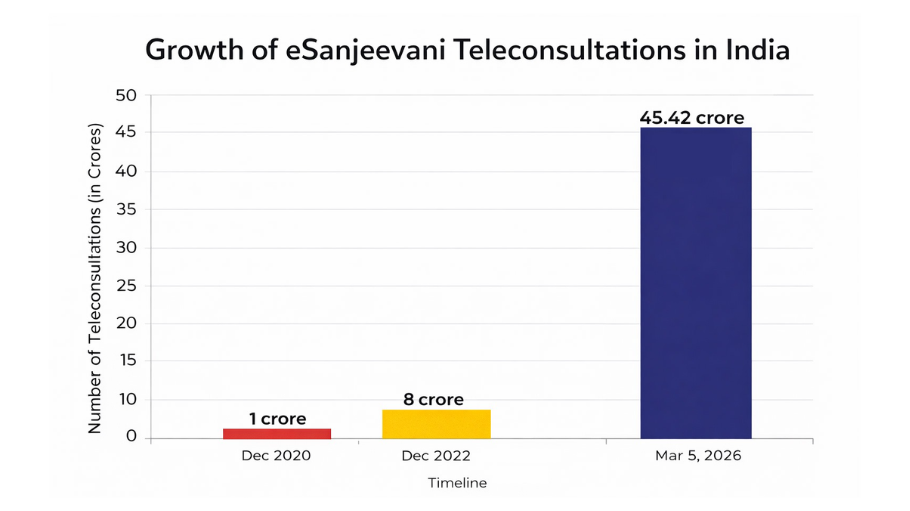
As of March 5, 2026, eSanjeevani had served 45.42 crore patients, which tells me telemedicine is no longer a side option in Indian healthcare. It is becoming a much more important part of how care is delivered.
The Rise of the Care Economy in India’s Healthcare Sector
When PM Modi spoke about the care economy, it felt like one of the most important signals in the healthcare discussion. This is not only about hospitals and treatment anymore. It is also about the growing need for caregivers, elderly support, rehabilitation, and long-term care as India’s health needs continue to change.
What stood out to me is that this is now being seen as both a healthcare need and a job opportunity. That is what makes it bigger. The conversation is clearly moving toward a model where caregiving is not treated as a side role, but as an important part of how the healthcare system will support more people in the years ahead.
And the reason this matters is easy to understand. According to UNFPA India, the share of people aged 60 and above in India is projected to rise from 10.5% in 2022 to 20.8% by 2050. To me, that is the real takeaway here: the care economy is no longer just a policy phrase. It is becoming a serious part of India’s healthcare future.
India’s Healthcare Workforce Gap and the Urgent Need for Training
When PM Modi spoke about new training models and stronger partnerships, it felt like one of the most practical parts of the healthcare discussion. Because no matter how ambitious the vision is, healthcare does not scale on infrastructure alone. It scales when there are enough trained people on the ground actually, to deliver care well.
Real Gaps
India’s healthcare system needs more trained people across roles, not just more doctors. Caregivers, nurses, technicians, and frontline support staff all matter if access has to improve in a real way.
Better Skills
Training now has to go beyond theory. The focus has to be on job-ready skills, digital familiarity, and the kind of practical support roles that the system will need much more of.
Stronger Delivery
A stronger workforce makes healthcare expansion more realistic. Without trained people behind the system, even good policy intent starts feeling uneven at the ground level.
Future Demand
The increasing need for medical professionals is becoming more critical because current demand exceeds existing supply. The WHO-supported report indicates that India requires 1.8 million additional doctors, nurses, and midwives to achieve its essential health worker requirement.
How Digital Health and AI Can Improve Healthcare Delivery in India
Stronger digital systems are essential for healthcare to achieve better scalability. The actual value of digital health and artificial intelligence lies in their ability to function as practical instruments that improve the speed and efficiency of healthcare delivery.
Digital records make care smoother: They help reduce information gaps and make it easier for patients to move across services without repeating the same details again and again.
AI can support faster decisions: It can help with triage, routine workflows, and clinical support, which makes day-to-day healthcare delivery more efficient.
Telemedicine becomes stronger: When digital systems and AI are added to telemedicine, remote care starts becoming more structured and much easier to manage at scale.
Patients get easier access: Digital tools can make consultations, records, and follow-ups simpler for people who would otherwise face delays or distance barriers. This is an inference based on the goals of India’s digital health systems.
Healthcare can scale better: A stronger digital layer helps the system serve more people without depending only on physical infrastructure. That matters a lot in a country as large as India. This is an inference based on the design of digital health and telemedicine systems.
Doctors get better support: The best use of AI is not replacing doctors. It is helping them work faster, stay more consistent, and handle routine tasks more efficiently. This is an inference supported by official references to AI-enabled decision support.
Real adoption is visible: According to an official ABDM update, the ABHA-based Scan and Share service has already enabled 3 crore OPD registrations, which shows digital health tools are starting to make hospital processes faster and easier.
How Ayushman Bharat is Supporting Better Healthcare Access Across India
Ayushman Bharat feels like one of the clearest examples of healthcare access moving from policy to actual delivery. It is not just about insurance coverage on paper. It is also about making healthcare more affordable, more local, and easier to reach for people who would otherwise struggle to access the system.
- It helps eligible families manage hospital treatment costs and reduces the pressure of major medical bills.
- It brings healthcare closer to villages and smaller communities through Ayushman Arogya Mandirs.
- It supports primary care by improving access to wellness services, early diagnosis, and basic treatment.
- It makes the system more usable by connecting patients to a wider hospital network.
- It also reflects changing healthcare needs, especially with greater attention on older citizens.
- It gives India a stronger base to improve healthcare access in a way that feels more practical and inclusive. This is an inference based on the scheme’s design and expansion.
From a founder’s perspective, that is the real value of Ayushman Bharat. It is helping healthcare feel less distant for millions of people and making access a much bigger part of the overall health system.
What PM Modi’s Healthcare Push Means for India’s Future
- It shows that healthcare is no longer being viewed only as a welfare need, but as a long-term growth priority.
- It puts much more focus on access, especially for people living beyond major cities and hospital networks.
- It makes workforce readiness a bigger part of the healthcare conversation, which is critical for real expansion.
- It gives telemedicine and digital health a more meaningful role in how care can reach more people.
- It shifts more attention toward prevention and early care instead of relying only on treatment-led thinking.
- It also makes one thing clear: healthcare progress will depend on how well access, skills, and delivery come together.
- The bigger insight here is simple: this is starting to look less like a set of separate health initiatives and more like a broader system shift.
Why Execution Will Be Critical for India’s Healthcare Progress
The vision sounds promising, but this is the point where execution starts to matter more than the announcement itself. Preventive care, telemedicine, skilling, and access all sound right on paper, but the real test is whether they actually come together in a way that works on the ground.
That is where the bigger opportunity lies. If these pieces connect well, India can build a healthcare system that feels more practical, more accessible, and far easier to scale.
I share more insights like this on how AI is evolving in real-world use. Feel free to connect with me here if you’re exploring similar ideas.
