
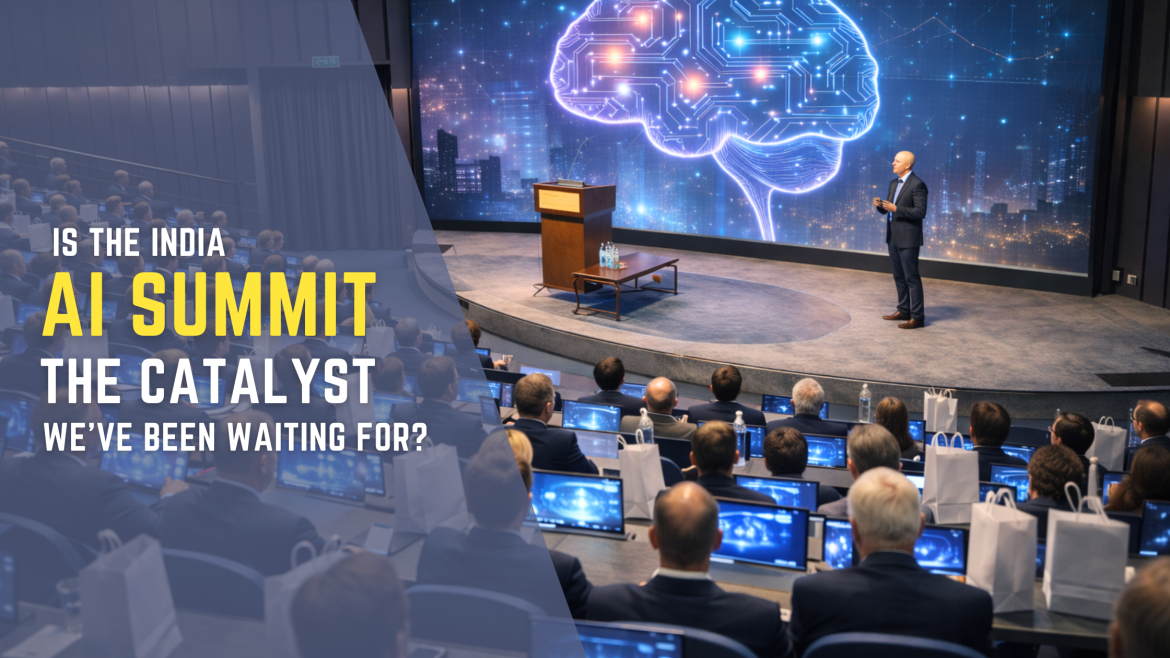
There are moments when you don’t need a headline to tell something important is happening. You can just feel it. The India AI Impact Summit felt like that for me. I’ve spent years working with technology, watching AI move from theory to tools, from labs to real products. But this time, it wasn’t about a new model or a product launch. It felt bigger. It felt like a shift in confidence.
When I read that India completed over 82B AI/ML transactions in just six months, nearly half of Asia-Pacific’s total activity, I paused. Not because of the number itself, but because of what it represents. This isn’t experimentation anymore. This is usage at scale. This is infrastructure quietly forming underneath everyday systems. The question is no longer whether emerging economies can adopt AI. It’s how fast they can use it to solve problems that actually matter.
At this point in my career, I’ve seen enough technology cycles to know when something is hype and when something is real. What I sensed around this summit wasn’t noise. It was intent. India isn’t just consuming AI tools built elsewhere. It’s starting to define how they should work, who they should serve, and why they should exist. And that’s what makes this moment feel different.
Seeing a Nation Take Control of Its Own Story
The India AI Impact Summit showed me that India has stopped treating AI as a technology that it uses from global sources. The country is currently developing its own AI system. The government has dedicated efforts during the previous year to establish national AI systems, which will help startups and researchers in their efforts to develop innovative solutions.
The shift enables India to transform from its previous role as an AI service provider into its new function as an AI technology developer.
There is also a strong focus on establishing AI accessibility for all users by creating systems that help startups, developers, and public institutions. The teams that understand the problems best drive actual innovation. Better access to computing power, tools, and datasets enables the development of real-world solutions that benefit multiple fields, including healthcare, agriculture, and public services.
- India’s recent changes show that the country is choosing to build its own artificial intelligence systems instead of depending on foreign technology.
- Startups and mid-sized companies are gaining improved access to artificial intelligence tools and computing resources.
- The current trend results in companies moving from research and development work on artificial intelligence to implementing the technology through actual system operations.
- The government and various institutions provide their support for the large-scale development of artificial intelligence technology.
- Emerging economies are beginning to develop their own artificial intelligence innovations while they also implement existing technologies.
The 2026 AI Impact Summit made it clear how much potential AI holds to transform our world. While challenges remain, I feel optimistic. Over the next ten years, AI will enable organizations to work smarter, foster stronger connections among people, and help create a more resilient and empowered world.
From Summit Conversations to Real‑World Change
At the India AI Impact Summit, one key insight emerged about AI research because its future depends on both research and testing activities, and the actual results that AI technology delivers to human society. The meeting brought together leaders and innovators, together with policymakers, to find solutions that AI technology offers for solving actual problems that will create advantages for local communities.
Across healthcare, agriculture, education, and public services, teams create solutions that show the languages and cultures and daily requirements of their communities. People can develop ideas that create positive results because they now have access to advanced computing power and extensive data resources. Society needs people to understand how to use available tools because they need both our existing tools and their expertise to properly operate them.
The summit emphasized that organizations face their main obstacle when they need to use their resources according to their established standards. The organizations and countries that succeed will be those that embed AI into daily systems with people and purpose at the centre. This moment enables both innovation and impact to merge because emerging economies use technology to demonstrate authentic and enduring transformations.
Global Collaboration at the Summit
The India AI Impact Summit in New Delhi attracted international interest because world leaders, senior ministers, and top technology executives participated in discussions about AI development and its impact on developing countries. India’s participation in international AI activities shows its rising power in the global AI field because India has become a major force that shapes worldwide AI development.
Earlier in 2026, Washington, D.C. hosted a pre-summit event where policymakers, technologists, and innovators gathered to prepare for the India AI Impact Summit. The focus was clear: co-creating the future of AI through collaboration between the Global South and North. International collaboration has become essential as AI technology advances from research facilities into public service and infrastructure development. The system requires this component to create solutions that produce actual benefits.
Feeling the World’s Eyes Turn to India’s AI Summit
India is hosting the India AI Impact Summit 2026 in New Delhi from February 16 to 20, bringing together global leaders, policymakers, and innovators. A recent report highlights that at least twenty heads of state and over 45 ministerial delegations are attending the summit. This shows how seriously the world is watching India’s role in shaping AI.
Prime Minister Narendra Modi has positioned India as a key voice in global AI development, with leaders like French President Emmanuel Macron participating in discussions. Hosting the summit in New Delhi highlights India’s ability to lead large-scale initiatives and bring the Global South into the AI conversation.
From my perspective, seeing world leaders and innovators together in one place is exciting. It’s a clear signal that India is not just adopting AI but guiding its responsible, inclusive deployment, showing how emerging economies can lead with vision and purpose.
India at the Centre of Global AI
The India AI Impact Summit highlighted that India has become more than a participant in the global AI competition, which now positions it as a key developer of AI construction and operational standards. India has developed the capacity to create AI systems that function at a national scale through its digital public infrastructure projects such as Aadhaar, UPI, and India Stack, which now need to integrate AI technology as their next core development element.
What sets India apart from other nations is that its market size enables companies to test their AI technologies in actual commercial environments. AI solutions are developed to function across various languages and cultural backgrounds and different community settings, which establishes complete accessibility from the initial design stage. The improved availability of computing resources and datasets, and development tools to startups, researchers, and public institutions enables them to create actual community benefits after their initial research phase.
By hosting the Summit, India demonstrates its support for AI leadership through AI solution development, which requires more than creating large AI models because AI must be used responsibly throughout society. Emerging economies can take inspiration from India’s approach. seeing that thoughtful deployment, backed by strong infrastructure and inclusive design, can turn potential into meaningful change for communities everywhere.
Guiding AI with Vision and Responsibility
At the 2026 AI Impact Summit, it became clear that organizations must handle two difficulties when they attempt to implement AI technology throughout their operations. Government and business organizations will develop successful programs when they combine new ideas with proper supervision to develop AI technologies that benefit people, society, and the economy.
True AI leadership requires organizations to establish their most important goals and develop their operational procedures while bringing together all required stakeholders. Summit participants showed that all organizations must collaborate because governments and startups, researchers and investors must work together to create solutions that meet all three requirements of inclusiveness, ethical standards, and operational efficiency. Leaders must develop AI systems, but their primary mission involves directing those systems toward uses that will create advantages for every user, including marginalized groups.
Key takeaways for AI leadership:
- Pair innovation with careful governance and purpose.
- Collaborate across sectors to build inclusive and ethical AI solutions.
- Ground decisions in the local context to ensure real-world impact.
- Focus on guiding AI adoption responsibly, not just on building technology.
The takeaway is clear: as AI moves from experimentation to impact, leaders who combine vision with responsibility will define the next decade.
Guiding AI With Purpose
The India AI Impact Summit framed its vision around three guiding principles, known as Sutras: People, Planet, and Progress. These principles are more than words; they are a blueprint for transforming AI from a technological concept into solutions that genuinely improve lives.
People
AI must be human-centred. It should be inclusive, respect cultural diversity, and ensure that communities across the country have access to its benefits. Designing AI with people in mind means understanding real-world needs and building solutions that serve everyone, not just a select few.
Planet
Innovation must be responsible. AI development should minimize environmental impact, support climate resilience, and contribute to sustainable growth. By embedding environmental responsibility into its core, AI can become a force that strengthens our planet rather than strains it.
Progress
AI should drive inclusive growth across healthcare, education, governance, and agriculture. Its purpose is to expand access to opportunities and create tangible improvements in everyday life, empowering individuals and communities to thrive.
The Chakras focus on collaboration and actionable solutions. The areas of study include human capital and social empowerment, plus safe and trusted AI, together with innovation and efficiency, plus science and democratization of AI resources and economic growth for social good. All AI development must adhere to the Chakra requirements, which require the use of collaboration and equity, plus real-world results to guide their operations.
At the Summit, it was established that effective AI leadership requires more than developing superior technological solutions. The goal of research is to create systems that demonstrate ethical principles while including diverse populations and achieving substantial positive effects. India demonstrates to the world how emerging economies can lead with purpose through its implementation of guiding principles that connect with specific focus areas to ensure AI benefits people and protects the planet while advancing progress for all people.
Building a Future That Belongs to Everyone
At the India AI Impact Summit, it’s clear that artificial intelligence research now extends beyond laboratories and particular nations. The actual task demands organizations to develop their systems in a way that enables them to function throughout various societies and cultural traditions and international boundaries. The creation of inclusive multilingual context-aware systems by India demonstrates how developing nations can establish AI as a technology that delivers actual benefits to society.
Earlier this year, the pre-summit meeting in Washington, D.C. established a framework for Global South and North countries to work together. The future of artificial intelligence will follow two main paths, according to the statement, which explains that partnerships between vision and responsibility will create ethical, human-centred, accessible systems. The way people choose to act through their inclusive decision-making process will determine how artificial intelligence affects society during the coming ten years.
Imagining a Better Tomorrow with AI
At the India AI Impact Summit, I realized that AI has evolved beyond being a mere instrument and current discussion subject. The technology now possesses the ability to bring about major changes in the world through its effects on both economic systems and personal human experiences. The summit unites international participants to show that technological progress reaches its greatest potential through partnerships between the Global South and North, which focus on creating purpose-driven, ethical systems.
What stood out most is that the choices we make today, together with our system deployment practices and community empowerment efforts, will determine the future of artificial intelligence according to current AI models. The upcoming decade will be defined by responsible leaders who possess future-oriented vision and collaborative abilities. These leaders will create sustainable social benefits through their innovations, which will bring permanent change to society.
