
If you’re still picturing trip planning as “someone lands on our site, scrolls a bit, then checks us on an OTA,” you’re thinking in an older internet flow. That journey still happens, but it’s no longer where most decisions begin.
Phocuswright’s consumer research makes this shift easy to see. Their chart shows traditional general search is still a major starting point, but it’s slipping, while generative AI platforms are rising fast as a way for people research and choose travel options.
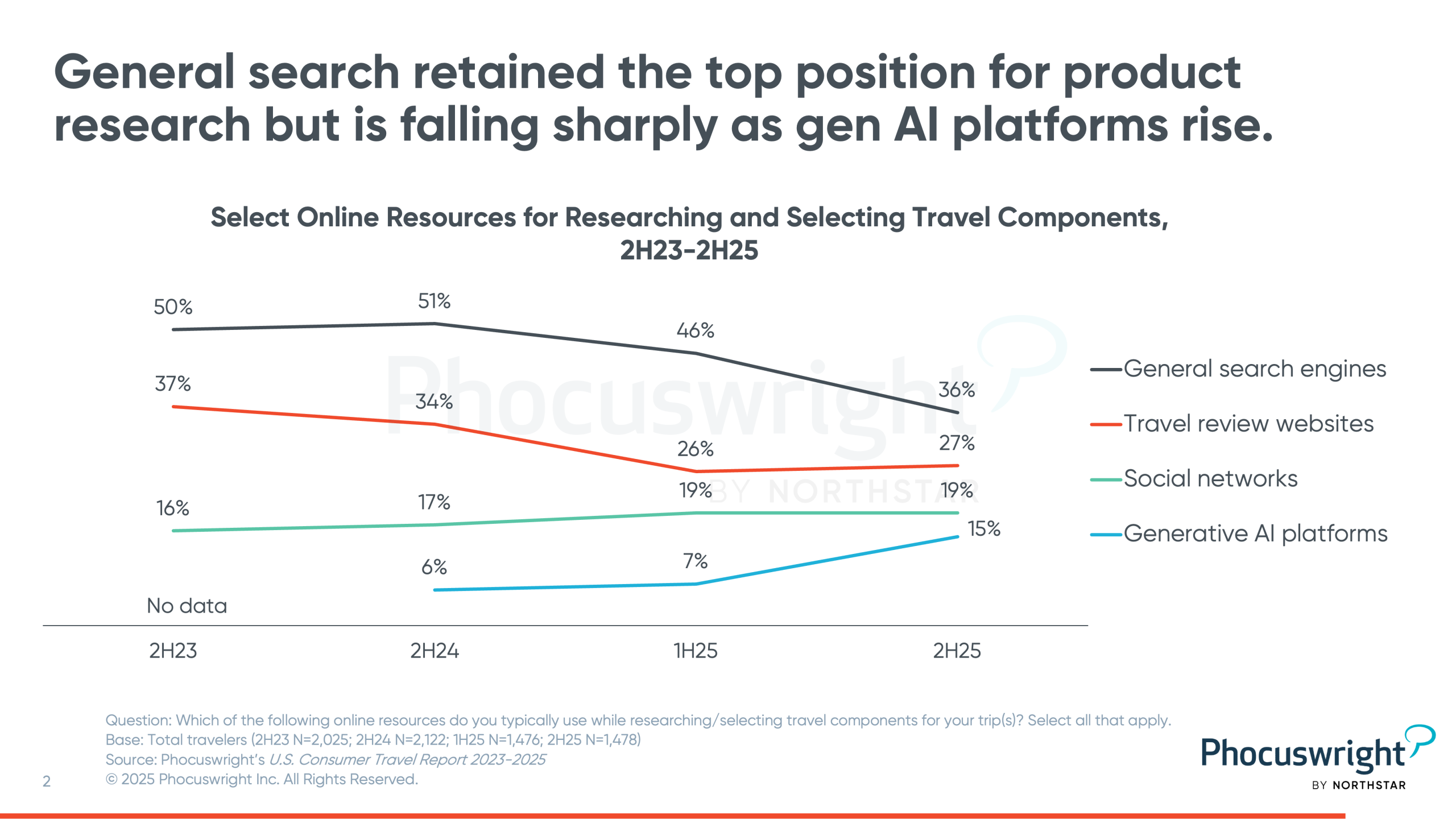
Image Resource: Phocuswright Research
In 2026, the starting line is increasingly AI and algorithm-led discovery. Deloitte’s hospitality outlook is clear that AI is already shaping trip discovery and inspiration. And the adoption curve is moving fast. Deloitte reports GenAI use for travel planning is expected to reach 24 percent in 2025, up from 16 percent in 2024 and 8 percent in 2023.
What that means on the ground is simple. Your front door isn’t your website anymore. It’s a rotating mix of reels, AI planners, and AI-shaped search results that guests treat like a shortcut to a decision. They don’t browse the way they used to. They ask for outcomes. A quiet hotel near the venue with late checkout. A best value boutique stay in a walkable area – a family-friendly option with a great breakfast and an easy airport transfer. And if your information is unclear or incomplete, you don’t just lose the booking. You often don’t even make the shortlist.
In 2026, your hotel isn’t competing for clicks. You’re competing to be the option an AI confidently shortlists.
How Google AI Mode is Turning Search into a Booking Channel
For a long time, hotels treated Google as a discovery tool. You showed up in search, the guest clicked, and the “real decision” happened on your site or an app. That model is changing because Google is turning search into a place where planning actually happens, not just where it starts. With AI Mode and Canvas, a guest can build an itinerary inside search, refine it, and keep iterating without ever doing the old tab-hopping routine.
Now zoom out and look at what this does to the funnel. When planning lives inside the interface, the guest is asking for a decision, not information. “Build me a three-day Cairo trip with a boutique stay near the key sites and a budget cap.” That’s not SEO. That’s an assistant experience. Google has also been expanding AI Mode’s agentic capabilities so it can help complete tasks like reservations by checking options across providers.
This is why I tell hotel teams to stop thinking “traffic” and start thinking “inclusion.” In an AI-led search flow, the win is not always a click. The win is being selected in the shortlist that the AI generates. And the inputs that decide the shortlist are practical. Accurate room and policy details, clear location signals, amenity specifics, and consistency across the web. If those basics are messy, you don’t get debated. You get skipped.
How Agentic AI is Changing Hotel Booking and Guest Ownership
Let me put this simply. When a guest uses an AI assistant to plan a trip, they are not shopping the old way. They are delegating the work. The assistant compares options, narrows to a shortlist, and the guest picks what feels safest and easiest. That small behavior shift changes the rules because your hotel is evaluated like a bundle of facts, not a brand story.
IDC puts a number behind where this is going. Their FutureScape predictions suggest that by 2030, about 30% of travel bookings will be executed by AI agents.
As someone who has implemented AI workflows, I can tell you what agents care about in practice. They hate uncertainty. They reward clarity. If your cancellation terms are vague, your fees are buried, or your amenities look different across channels, you do not get a warning. You just quietly drop out of the shortlist. The win condition changes from getting clicks to being easy to understand, trust, and book.
Key takeaways
- Agent-led booking shifts power to the shortlist stage.
- Clear policies, fees, and inclusions matter more than clever copy.
- Consistency across your website, apps, and metasearch keeps you visible.
- Being easy to evaluate is now a direct booking strategy.
Why Structured Hotel Data is Critical for AI-Driven Discovery
Let me say this the way I say it to hotel teams when we’re scoping AI work.
If a guest asks a simple question and your team has to “check with someone” every time, it’s not a service problem. It’s a data problem. The truth is scattered. Some of it is on your website, some of it is in travel agency fields, some in PDFs, and a lot of it lives in people’s heads.
In an AI-led journey, that mess shows up earlier. AI doesn’t experience your hospitality first. It experiences your information first. It compares you to a set of facts. If those facts are inconsistent or missing, the AI either makes assumptions or skips you.
This is why chatbot projects often disappoint. The interface looks fine. The answers sound confident. But the knowledge underneath is shaky. A Hospitality Net interview referenced an estimate that about 60% of hotel data isn’t formally documented in a structured way.
My take is simple. AI doesn’t create accuracy; it scales whatever you already have. Clean data becomes leverage across discovery, booking, pre-stay questions, on-property service, and staff copilots. Messy data becomes confusing at scale.
So before you buy another “AI experience,” build the boring thing first. One living knowledge base with clear ownership and a simple update habit that your team can actually maintain.
This foundational discipline is what separates hotels experimenting with AI from those actually winning in AI-driven discovery – something I regularly break down in more depth at Bhavik Shah.
Why Data Freshness Determines AI Recommendations
This is the part of AI in hospitality nobody gets excited about, but it’s the part that decides whether you win. Hotels are living systems. Hours change. Menus rotate. A pool goes under maintenance. A renovation pops up for two weeks. A seasonal perk appears, then disappears. None of that is unusual. What’s risky is when your updates don’t travel. One channel shows the new info, another still shows the old version, and the guest ends up confused before they’ve even booked.
A Hospitality Net interview with Quinta’s founder put a real number on how often this happens. He estimated that roughly 15-20% of a hotel’s data needs to be updated every year.
Now here’s why this matters more in 2026. AI-led discovery runs on confidence. If an assistant is recommending a stay, it needs to trust that the details are correct right now. When your breakfast timing is one thing on an OTA and another on your website, or a fee shows up in one place but not another, the AI doesn’t debate it. It either fills the gap with a guess or quietly recommends a property that looks more reliable.
Key takeaways
- Outdated info can remove you from the shortlist before a guest clicks.
- Freshness builds trust, and trust drives inclusion in AI recommendations.
- The fastest AI win is usually a better update habit, not a new chatbot.
Why Hotels Need a Single Source of Truth Across All Platforms
If your hotel information lives in five places, you are basically running five different hotels online. One version on your website, another on Booking, another on Expedia, something else on Google, and a totally different set of details inside an AI planner that scraped an old page. Guests feel that inconsistency instantly. And AI systems treat it as uncertainty, which is the fastest way to fall out of the shortlist.
The fix is not “work harder.” It’s deciding that there is one real source of truth and everything else pulls from it. Rates and inclusions, policies, amenities, hours, seasonal notes, even the small stuff people actually ask about. Once you have that, distribution becomes boring in the best way, because updates stop being a game of whack-a-mole and start being a single change that propagates everywhere.
How AI Enables Real-Time Personalization in Hospitality
Personalization used to be something you “sent” to guests: a discount, a loyalty email, and a pre-stay upsell that still exists. But in 2026, the real upgrade is happening quietly in the flow of the trip. Guests don’t want more messages. They want fewer decisions. The right room preference without a back and forth. The right check in the path when they land late. The right suggestion when it actually helps, not when it hits a marketing calendar.
The way I explain it is simple. Great personalization feels like you remembered me without making it weird. It’s not “we know everything about you.” It’s “we removed friction at the moments you care about.” When you get that right, it doesn’t feel like personalization. It just feels like a smoother stay.
How AI Copilots are Changing Hotel Operations
- For a while, AI in hotels mostly meant one thing: a chatbot answering guest questions. Useful, but it barely touches the real workload.
- What’s changing now is where AI sits. It’s moving behind the scenes to support your teams, not just talk to guests. That’s where you actually feel the impact day to day.
- Think of copilots as a quiet extra team member your staff can lean on. The front desk gets the right policy instantly. Reservations replies faster with accurate details. Ops teams can triage issues based on patterns instead of guesswork.
- The best use cases are not flashy. They are the ones that remove friction. Summarizing a guest’s preferences before arrival. Flagging special requests. Suggesting the right next step when something goes wrong.
AI works best when it makes your people sharper, not when it tries to replace hospitality. Guests still want humans. They just want humans who are informed, fast, and consistent.
Why Trust, Transparency, and Control are Critical for AI Adoption
Here’s what I’m seeing everywhere. Guests are fine using AI to research and shortlist. The hesitation kicks in when AI tries to act. Skift’s research shows the gap clearly. More than 90% of consumers say they trust AI-generated travel information, but only about 2 percent currently allow AI to book on their behalf.
That tells you the real blocker is confidence, not capability. So the trust play is practical. Make it clear what the system is doing, what it is using, and what it will never do without confirmation. Give guests and staff simple receipts, clear policies, and an easy override. In 2026, trust is not a tagline. It is a workflow.
Key takeaways
- People trust AI for research far more than for bookings.
- Transparency and control are what unlock adoption.
- Safe AI experiences win over “magic” demos.
How AI Copilots are Transforming Hotel Operations
- For a while, “AI in hotels” basically meant guest chat. Answer a few FAQs, deflect a couple of calls, call it innovation. Helpful, but it barely touches the real workload your teams carry every day.
- The shift in 2026 is where AI sits. It’s moving behind the scenes to support staff decisions in real time, not replace hospitality. Think quick policy lookups at the front desk, faster, more accurate reservation replies, smarter escalation for maintenance issues, and instant summaries of guest context so your team doesn’t have to start every interaction from zero.
- You can feel the direction the industry is heading in the adoption signals. NielsenIQ reported that about 72% of hospitality venue leaders said they’re likely to implement AI solutions in the next 12 months.
- The best copilots are not flashy. They reduce friction. They help staff answer confidently, stay consistent, and move faster during peak hours, when mistakes are most likely to happen.
Emerging AI Technologies Reshaping Travel Experiences
If you want to see what’s actually creating hype right now, look beyond chatbots. The exciting stuff is AI that shows up inside the trip and makes it feel smoother or more memorable. Real-time translation that saves you from awkward moments. Smart guides that adjust to what you’re into as you move around. AR storytelling that turns a historic site into something you actually feel, not just read.
You can see the trend in what teams are actively building. At Capgemini’s “Hack the Future of Tourism in Egypt“, students prototyped AI tour guides, itinerary optimization, AR-led storytelling, predictive demand insights, and real-time translation. That mix tells you where the industry is heading. Less “AI answers questions” and more “AI upgrades the experience.”
A 90-Day Roadmap to Make Your Hotel AI-Ready
If you try to “do AI” as one big project, it usually turns into a mess of demos, tools, and stalled rollouts. The way to win is to treat it like operational change. Start small, fix the foundations, then scale what works. Here’s a simple 90-day plan I’ve seen teams execute without chaos.
Days 1 to 30
Pick one priority journey to improve, usually trip planning, pre-stay questions, or booking support. Audit your top 50 guest questions and identify where the truth currently lives. Then create one clear source of truth for policies, amenities, hours, inclusions, and fees, with an owner for each category.
Days 31 to 60
Connect that knowledge to the channels guests actually use. Website, OTAs, Google listings, and your AI layer. Add a lightweight update workflow so changes get published everywhere quickly. Train staff on the new system so the human answers and the AI answers match.
Days 61 to 90
Launch one high-impact AI workflow. A booking assistant that knows your policies and inventory rules. A staff copilot that helps front desk and reservations respond faster. Or a personalization layer that improves pre-arrival and on-property experience. Measure three things only. Shortlist inclusion, conversion rate, and support load reduction.
Key takeaways
- Foundations first wins over flashy tools.
- One source of truth plus updates beats more bots.
- Ship one workflow in 90 days, then expand from proof.
Clarity is the Real Advantage in 2026
AI won’t be the thing that makes your hotel “feel modern.” Clarity will. The hotels that win in 2026 will not be the ones with the fanciest bot. They will be the ones that are easiest to understand, easiest to trust, and easiest to book, everywhere a guest makes a decision.
