What Perplexity’s Health Advisory Board Really Signals for Healthcare AI
Perplexity is stepping into a category where strong answers and polished UX are not enough on their own. Accuracy, clinical credibility, and clear safeguards are what decide whether people take the product seriously.
Bhavik Shah
AI Implementation Expert & Founder of TechnoBrains
Most people will see Perplexity’s Health Advisory Board as just another product update. I think it signals something bigger. Healthcare AI is entering a phase where trust matters as much as the technology behind it.
That is why this move stands out to me. Perplexity is stepping into a category where strong answers and polished UX are not enough on their own. Accuracy, clinical credibility, and clear safeguards are what decide whether people take the product seriously.
The shift is already happening across the market. The AMA’s 2026 physician survey found that 81% of physicians reported some awareness or use of AI in 2026. Healthcare is no longer asking whether AI is here. The real question now is which companies can make it trustworthy enough to last.
Healthcare AI is Built on Trust, Not Just Technology
What I find most interesting about Perplexity’s Health Advisory Board is that it quietly acknowledges something a lot of AI companies still try to out-design or out-market. In healthcare, the product does not win just because it is smart. It wins when people believe it is safe, credible, and grounded enough to sit anywhere near a real health decision.
That is why healthcare AI behaves differently from most other AI categories. A fast answer is not enough. A polished interface is not enough. Even a strong model is not enough on its own. If a patient questions the credibility of the output or a clinician doubts the guardrails behind it, the product loses trust immediately. And once trust slips in healthcare, adoption gets a lot harder to recover.
This is exactly where I think Perplexity is being more realistic than many AI companies. The board is not just about optics. It signals that healthcare AI needs a stronger trust layer around the product itself. The AMA’s 2026 physician survey found that 40% of physicians are equally excited and concerned about AI, which tells me the opportunity is real, but so is the hesitation. In a category like this, technology can open the door, but trust is what decides whether anyone stays.
Why Healthcare AI Needs More than Just a Powerful Model
A lot of AI companies still talk about healthcare as if the hardest part is building a better model. I do not see it that way. In healthcare, a powerful model is only one part of the equation. The real challenge is whether that model can be trusted inside messy workflows, incomplete data, clinical judgment calls, and situations where a wrong answer carries real consequences.
It has to work with fragmented records and uneven data quality.
It has to fit into real clinical workflows instead of sitting outside them.
It has to be explainable enough that clinicians feel comfortable using it.
It has to hold up across edge cases, not just ideal demo scenarios.
It has to support decisions without pretending to replace clinical judgment.
This is exactly why strong model performance alone does not create adoption in healthcare. Doximity’s 2026 State of AI in Medicine report found that 71% of physicians cite accuracy and reliability as their top concern with AI-generated outputs. That tells me the market is not waiting for a more impressive model. It is waiting for AI products that are dependable enough to earn real-world trust. That is also why Perplexity’s move matters. The advisory board signals an understanding that in healthcare, capability gets attention, but reliability is what gets accepted.
The Real Role of Governance in Building Reliable Health AI
Governance is what gives healthcare AI clear boundaries. It defines what the system can do, what it should not do, and where human review is still required.
In healthcare, reliability is not judged by how well a model performs in a demo. It is judged by how consistently it handles sensitive data, complex workflows, edge cases, and real clinical use.
This is why governance matters so much. It creates structure around validation, accountability, monitoring, escalation, and decision-making before the AI is used in high-stakes settings.
Without that structure, even a capable model can become difficult to trust. The issue is not only whether the answer is useful. It is whether the process behind that answer is safe, traceable, and aligned with clinical expectations.
Governance also plays a major role in adoption. Health systems and clinical teams are more likely to use AI when there are clear rules for oversight, quality checks, and risk management.
As healthcare AI expands, governance is becoming a core requirement rather than a secondary layer. Deloitte found that 82% of leading healthcare companies either have or plan to implement governance and oversight structures for generative AI. That reflects how strongly the market is linking AI adoption with control, safety, and long-term reliability.
Perplexity Health Reveals the Bigger Strategy Behind the Advisory Board
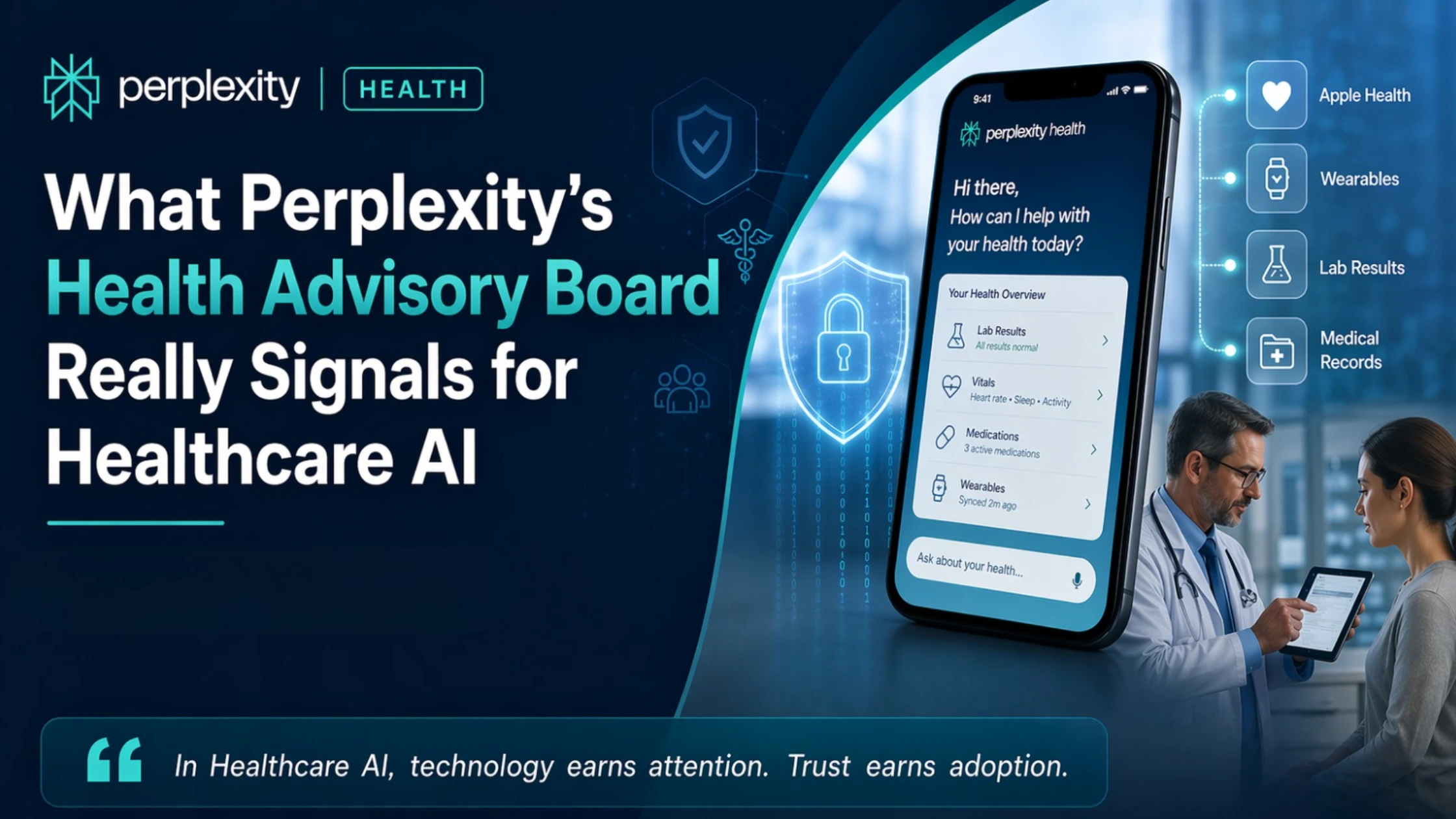
The most important thing about this launch is that the advisory board is not the full story. It sits inside a much bigger product move. Perplexity Health is being positioned as a personal health layer that connects medical records, lab results, and wearable data, then turns that into more contextual answers, tracking, and dashboards. Coverage across the launch keeps pointing to the same idea: this is not just Perplexity trying to sound more credible in healthcare. It is Perplexity building a larger consumer health AI product and adding the trust layer alongside it.
The advisory board gives the healthcare move more clinical weight, but the real expansion is Perplexity Health itself.
Perplexity Health connects Apple Health, wearables, lab results, and medical records, so answers can be based on personal data instead of only public web information.
The product is also being framed around dashboards, personalized health insights, and future health applications built on top of Perplexity Computer.
That makes the strategy much bigger than search. It moves Perplexity closer to becoming a health interface where AI helps organize and interpret scattered personal health information.
Once a company makes that shift, advisory oversight stops looking optional. It starts looking like part of the product architecture.
One detail makes that strategy easier to understand. Through its partnership with b.well, Perplexity says users can connect records from a network covering more than 1.7 million healthcare providers. That matters because it shows the company is not testing a narrow health feature. It is building toward a much broader personal health data platform where trust, access, and usability all have to work together.
The Bigger Opportunity: AI-Powered Personal Health Data Platforms
The real opportunity here is not just a better health search. The project aims to create usable personal health data that has remained inaccessible until today. The current situation prevents people from understanding their health status because their health information exists throughout multiple sources, which include wearables, hospital portals, lab reports, and wellness apps. Perplexity Health platforms are developing an AI-based system that will combine various components to create understandable content.
That is where the real value starts to grow. Once AI can work across records, biometrics, and health history in one place, the experience shifts from generic answers to more personal insight. Perplexity’s partnership with b.well connects users to a network of more than 1.7 million healthcare providers, which shows this is much bigger than a simple feature launch. It is a push toward a connected health data platform people can actually use.
When AI Gets Personal: The Risks of AI in Healthcare
The risk changes the moment healthcare AI starts working with personal data instead of answering general questions. At that point, it is not just about getting a useful response. It becomes about whether the system is reading the right records, understanding the right context, and staying within safe limits. That is where healthcare AI gets much more sensitive.
A missed detail in a lab report, a weak summary of someone’s medical history, or an answer that sounds too confident can create real problems fast. In a space like this, even a helpful product can lose trust quickly if it feels careless. The more personal the experience, the more accuracy, restraint, and safety matter.
Privacy, Trust, and Clinical Credibility: What Drives Adoption in Healthcare AI
In the field of medical AI, products should retain user trust in their existence because users perceive them to be intelligent. Users maintain product usage because they experience secure product performance. Users will lose their trust in a tool that delivers quick results and high-quality performance because they cannot determine what happens to their data and how accurate the results actually are.
That is why adoption in this field requires different procedures because businesses need to establish actual privacy protections, which should not require customers to read through extended legal documents. The product needs to show its clinical credibility through its actual performance, which includes creating usage limitations and answering confidential inquiries. The product establishes responsible boundaries that users can trust after those features are implemented.
What Most AI Companies Still Get Wrong About Healthcare
They treat it like any other AI market: A lot of teams go into healthcare with the same mindset they use for search, support, or productivity tools. That usually falls apart quickly because healthcare comes with a much higher trust bar and much less room for mistakes.
They build tools instead of fitting the workflow: Some products look great in isolation, but feel awkward once they hit real care settings. If the tool does not fit naturally into how clinicians and teams already work, people stop using it.
They underestimate how messy the data is: Health data is rarely neat or easy to work with. It is often spread across records, portals, and systems, which makes the real-world challenge much bigger than it looks in a product demo.
They focus too much on the model: A strong model helps, but that is only part of the story. In healthcare, people also need safeguards, consistency, and clear human oversight before the product starts to feel dependable.
They expect adoption to happen too fast: Healthcare teams do not trust a tool the moment it launches. They need time, proof, and enough confidence to believe it will help without creating new problems.
The Companies That Win in Healthcare AI Will Be the Ones People Trust
As the founder of TechnoBrains, I see one thing becoming very clear in healthcare AI. The companies that win will not be the ones that launch the fastest or talk the loudest. They will be the ones who build products people genuinely trust enough to use when the stakes are high.
That is what makes moves like Perplexity’s more important than they first appear. The real signal is not just that AI is entering healthcare. It is that healthcare AI now demands a different level of product discipline. The next winners in this market will be the ones that combine useful AI with strong safeguards, real credibility, and an experience that feels safe enough to rely on.
Ready to Build Production AI?
Let's discuss how to bring these patterns into your organization.
Schedule a Consultation →