
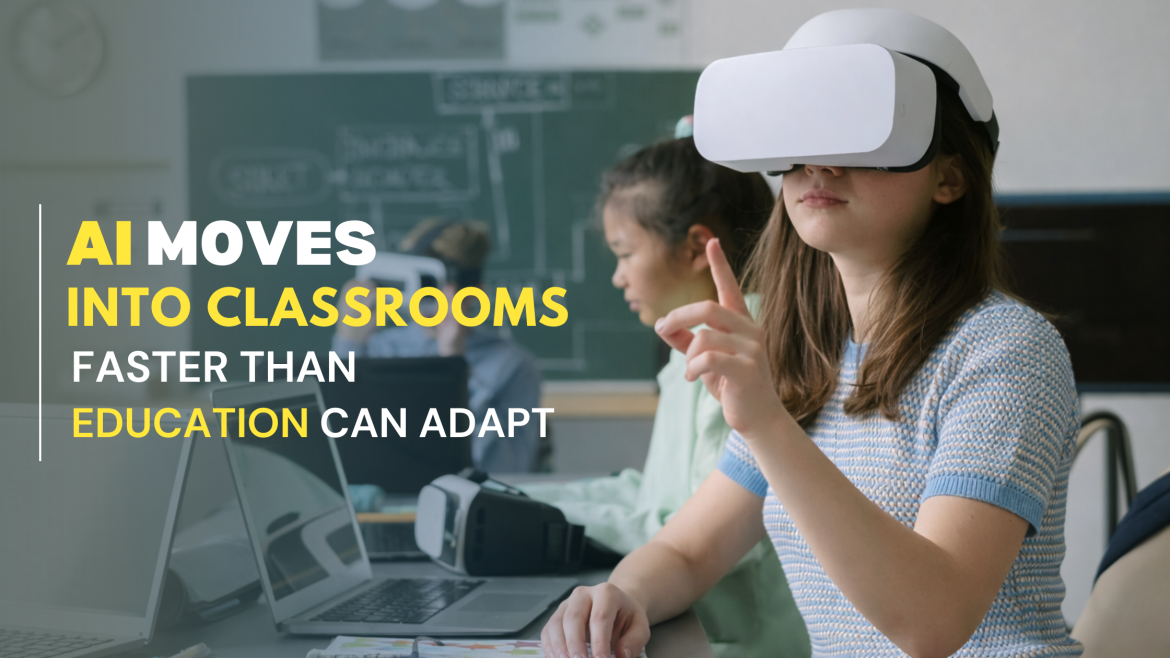
Generative AI didn’t just tiptoe into education; it showed up in classrooms almost overnight. Now, students are turning to tools like ChatGPT to help with essays, assignments, and even quick lesson summaries. Teachers are experimenting too, using AI to plan lessons and speed up grading. The shift has been so fast that many schools began using these tools before they had a chance to set clear rules or guidelines.
You can see the shift in the numbers. Just last year, only a handful of students were using AI for schoolwork. Now, 26% of US teens say they use ChatGPT, according to Pew Research. That’s twice as many as before. AI has already shifted from a novelty to a normal part of academic life.
But while students and teachers rush ahead, policies are lagging. UNESCO is sounding the alarm, reminding us that AI’s growth is outpacing the rules meant to guide it. What’s different now is that generative AI can actually create the same work we used to measure learning. This challenges all of us to rethink what really counts as knowledge, effort, and critical thinking in education.
The Cognitive Trade-Off Leaders Are Now Confronting
AI can truly help students learn faster, but it also creates an easier path for them to bypass essential learning. The tool begins to lose its boundary between “support” and “substitution” when it can explain material while creating a framework that allows users to complete their tasks. The actual trade-off occurs because AI produces immediate results, which create short-term advantages but lead to permanent damage to thinking abilities when users make AI their primary tool.
A strong data point comes from the OECD Digital Education Outlook 2026 through its research findings. The study presents a Europe-wide study that includes 7000 students to examine their AI usage during study sessions outside of school. The European average shows 56% use AI to get information, 45% to explain concepts, and 31% to provide complete solutions to tasks. The last number becomes important because it represents the point at which learners begin to rely on others instead of developing their own understanding.
Here’s the takeaway in simple terms:
- Learning can be enhanced through AI systems, which provide information and explanations to users.
- AI tools that offer complete solutions to problems let users skip both practice sessions and their essential problem-solving tasks.
- Teachers are adapting at different rates to new teaching methods. The same OECD report cites TALIS 2024 data showing 36% of lower secondary teachers across OECD countries used AI in their work, with wide variation (around 75% in Singapore and the UAE vs under 20% in France and Japan). The existing gap between schools determines the degree to which students receive training on proper AI usage.
Why Education Leaders Are Now Focused on Protecting Human Intelligence
The debate surrounding AI in education is no longer centred on tool access. The core mission of educational institutions now faces a threat. University administrators evaluate which portion of academic obligations students should manage while machines handle the rest as generative systems advance.
In a widely discussed editorial, Matthew Connelly, vice dean at Columbia University, argued that teachers must protect and develop human intellectual abilities. The line established a new perspective on the issue. The risk is not artificial intelligence becoming smarter. Students will experience a decline in their capacity to perform independent thought.
When essays can be generated instantly and reasoning structured automatically, output quality may improve. The system makes it difficult to evaluate the components of effort, analysis, and original thought. Educational methods will evolve into outcome measurement systems when convenience establishes itself as the primary approach to learning. The pressure manifests itself through these hidden expressions of anxiety.
- Students are asking fewer deep questions.
- Increased reliance on AI for first drafts and final answers.
- Reduced tolerance for intellectual struggle.
- Greater trust in machine responses than personal reasoning.
The challenge is not stopping innovation. It is ensuring that AI strengthens human capability rather than slowly weakening it.
AI Literacy Is Becoming a Core Academic Skill
Students are learning to use AI quickly. What they are not always learning is how it works. There is a difference between generating an answer and understanding where that answer comes from. When AI becomes the first place students turn for explanations, summaries, or solutions, the habit of questioning can slowly weaken.
AI literacy is not about turning every student into a programmer; it is about equipping them to evaluate outputs, recognize limitations, and approach results with judgment. Recent data shows that 42% of K–12 students in the US interact with AI‑based learning tools daily, yet many receive little structured guidance on how these tools work or how to assess their reliability.
Uneven AI Access Is Creating New Educational Inequalities
As AI tools become part of mainstream education, differences in access begin to influence learning outcomes. The advantage is not only in having the tool but in how it is introduced and guided.
- Schools with structured AI policies create clearer boundaries and better learning habits.
- Students with trained teachers receive direction on when and how to use AI effectively.
- Institutions with stronger infrastructure can experiment responsibly and scale gradually.
- Classrooms without guidance risk normalizing overreliance instead of skill development.
Why Governance Must Precede Large-Scale AI Deployment in Education
A familiar pattern emerges during every major technology transition. The institutions introduce new technologies, but their protective measures arrive at a later time. The AI implementation within educational systems creates permanent difficulties according to this particular pattern of events. The establishment of clear usage policies and defined academic boundaries, together with strong data protection standards, must occur before AI implementation in classroom settings.
Responsible deployment of technology also requires teacher training before schools give students access to new resources. The training process, together with monitoring activities and evaluation of results, should receive priority above everything else. Innovation requires intentional leadership to achieve its maximum effectiveness. Organizations that implement AI systems without proper structural systems operate efficiently, but their long-term success depends on establishing responsibility and transparency from their initial stages.
Where AI Is Already Delivering Meaningful Educational Value
The conversation about artificial intelligence in education often highlights potential dangers. But in the right context, AI is already helping in meaningful ways. The key is using it to support learning, not replace it.
- The solution helps teachers develop lesson plans, assess student work, and manage their administrative responsibilities, which gives them more time to work with students.
- The solution helps language learners by providing easier text materials and customized learning support.
- The system provides accessibility solutions for students with learning differences, which include speech-to-text capability and content that adjusts to their needs.
Students develop their abilities through guided feedback, which helps them learn until they reach the final answer.
When used responsibly, AI technology strengthens educational environments. The solution provides teachers with extra time for instruction while creating multiple ways for students to participate in learning activities.
The Strategic Choice Education Leaders Must Now Make
AI is not just a passing technology because it has become integrated into student learning processes, teacher work methods, and institutional operations. The actual inquiry examines the future of AI in educational environments rather than its presence in those spaces. The development of AI will depend on which educational institutions decide to implement it.
Today, educational institutions must decide between two options. The system will use AI as its main learning method because it offers fast and easy learning. Educational institutions should establish methods to enhance students’ thinking abilities through AI technology, which should work to develop their skills and provide them with new learning possibilities. Educational institutions that demonstrate decisive actions will create a framework that governs student AI usage while teaching them to think critically about the technology throughout their academic journey.
The Questions the Industry Must Now Confront
Across policy forums, university leadership panels, and global tech discussions, one pattern is clear. The conversation has moved beyond adoption. The real debate is about direction.
These are the questions shaping serious industry discussions today:
- Are we strengthening human capability or simply increasing efficiency?
- Are students learning to think with AI or depending on it to think for them?
- Do institutions fully understand the long-term impact of AI on assessment and academic integrity?
- Are we training teachers at the same pace that we are introducing tools?
- Who is accountable when AI influences learning outcomes at scale?
- Will education systems lead AI integration, or will technology providers define it for them?
The answers to these questions will determine whether AI becomes a catalyst for deeper learning or a shortcut that weakens it. The next phase of AI in education will not be defined by new models but by the clarity of the decisions institutions make now. These are conversations I continue to explore on my blog, focusing on how AI can be implemented responsibly at scale.
