
I’ve seen a lot of AI trends get packaged as bigger than they really are. This one feels different. Open source AI agent platforms are getting attention because businesses are no longer impressed by agent demos alone. They want systems that can actually shape around their own workflows.
What is changing now is the conversation itself. It is moving away from “which agent looks smartest?” and toward “which platform gives us control, flexibility, and real operational use?” That is a much more serious shift, and to me, that is where the market starts becoming real.
The demand is already there. Sources say about 69% of Australian organizations are already using autonomous AI agents, while only 22% have advanced agent governance models. That gap says a lot: adoption is moving faster than control, and that is exactly why open agent infrastructure is becoming such an important part of the discussion.
Why Enterprises are Prioritizing Open Source AI Agent Platforms
Conversations about Artificial Intelligence agents have reached an advanced stage of development. The business sector has stopped viewing AI agents as experimental research tools that exist outside of their main operations. Organizations now treat these systems as essential workplace tools that operate at the core value of business performance.
Key takeaways
- Enterprises want more than a smart interface. They want control, flexibility, and room to adapt agents to their own workflows.
- Open source platforms are getting attention because they make it easier to inspect, extend, and integrate agent systems without being boxed into one vendor’s roadmap.
- Adoption is clearly moving forward. 14% of organizations have already implemented AI agents at partial or full scale, while 23% have launched pilots.
That is why this category feels bigger now. Once agents start moving into support, operations, IT, finance, or internal process automation, the discussion changes fast. It stops being about which tool looks impressive in a demo and starts becoming about which platform can actually support real business use without creating bigger problems later.
Also read, Is your AI Actually Delivering Real Business Impact?
How Nvidia NemoClaw Signals a Shift Toward Open AI Agent Infrastructure
NVIDIA’s NemoClaw matters because it makes the market direction harder to ignore. When a company that already sits at the center of AI compute starts pushing into open agent software, it usually means the next competitive layer is moving beyond hardware and models. The focus is shifting toward the platform layer where agents are built, connected, governed, and deployed.
Key takeaways
- It shows that AI agents are moving closer to real business infrastructure, not just demo culture.
- It shifts the conversation from “which model is better?” to “which platform can manage agents in production?”
- It gives more weight to open platforms built around observability, orchestration, and lifecycle control.
- NVIDIA already has open pieces in place through its NeMo Agent Toolkit.
- Its broader NeMo stack is already positioned around the full AI agent lifecycle, including evaluation, policy enforcement, and observability.
- That makes NemoClaw feel less like a random launch and more like part of a larger software push around agents.
- NVIDIA’s recent outreach to Salesforce, Cisco, Google, Adobe, and CrowdStrike demonstrates that the company is developing its product for actual business use from its initial stages.
- Today, the current state of open agent infrastructure demonstrates its evolution into a substantial ecosystem development rather than remaining a testing platform for developers.
- One number that stands out: Nvidia is reportedly planning to invest $26 billion over five years in open-weight AI models, which makes its open AI push look much bigger than a one-off move.
How Open Source AI Agent Platforms Differ from Traditional Chatbots
The difference is bigger than the interface. A traditional chatbot is mostly built to respond, while an AI agent platform is built to take action across steps, tools, and workflows. That is why this category matters more now. Gartner says 33% of enterprise software applications will include agentic AI by 2028, up from less than 1%, which shows how quickly the market is moving beyond basic chat experiences.
| Traditional AI chatbots | Open source AI agent platforms | |
|---|---|---|
| Core function | Answer questions and handle simple conversations | Plan, reason, use tools, and complete multi-step tasks |
| Interaction style | Reactive and prompt-based | Goal-driven and action-oriented |
| Memory and context | Usually limited to the current session | Can retain memory, task state, and workflow context |
| Tool access | Often narrow or fixed | Built to connect with APIs, databases, apps, and external tools |
| Autonomy level | Needs regular user input | Can move through tasks with less hand-holding |
| Customization | Usually tied to a vendor’s interface and limits | Easier to inspect, adapt, and extend through open frameworks |
| Business use | FAQs, support replies, and simple assistance | Workflow automation, internal operations, and task execution |
| Governance needs | Lower because the scope is smaller | Higher because the system can take actions, not just generate answers |
Key Features to Look for in an Open Source AI Agent Platform
Not every open source AI agent platform is built for the same kind of work. Some are good for testing ideas. Others are built to support real workflows, real controls, and real business use. That is the difference worth paying attention to.
Agent orchestration
A strong platform should help agents handle multi-step tasks in a structured way. It should support workflow logic, task flow, and coordinated actions so the system feels useful beyond a basic prompt-response setup.
Tool and API integration
The platform should connect cleanly with APIs, apps, databases, and internal systems. Without strong integration support, even a smart agent stays limited because it cannot interact properly with the systems where the actual work happens.
Memory and context handling
A useful platform should help agents retain the right context across steps and tasks. That makes the output feel more consistent, more relevant, and far less fragmented when the work moves beyond a single interaction.
Permissions and access control
The platform should make it easy to define what an agent can access and what it cannot. Clear access controls matter because they help keep automation useful without giving the system more freedom than it actually needs.
Observability and tracing
A reliable platform should let teams see what the agent did, what tools it used, and where something failed. That level of visibility makes testing, debugging, and trust much easier once the system is used in production.
Guardrails and approval flows
The platform should support limits, checks, and approval points before important actions are completed. That keeps the agent useful while still giving the business enough control over how decisions and actions move forward.
Model flexibility
A good open platform should give teams the freedom to work with different models as needs change. That flexibility matters because model choice often depends on cost, speed, performance, or the type of task involved.
Deployment flexibility
The platform should work across cloud, hybrid, or private environments without making deployment harder than it needs to be. That kind of flexibility becomes important when business, security, or infrastructure needs start to vary.
Security foundations
Security should be part of the platform from the beginning, not something added later. Features like isolation, auditability, and controlled execution matter because agents become far more sensitive once they touch real systems and data.
If you want to explore more breakdowns like this, you can check out other insights, where similar AI topics are covered in depth.
Why Security and Isolation Matter the Most
This is where AI agents stop feeling excited and start feeling risky. Once an agent can access tools, files, apps, or internal systems, even one wrong action can create a real problem. That is why security is no longer a side concern in this space.
Isolation matters because agents need clear boundaries from the start. A controlled environment makes it easier to limit access, track actions, and contain mistakes before they spread into something bigger. That is exactly why sandboxed and container-based execution is getting more attention in the market. The goal is not just to make agents more powerful, but to make them much safer to use inside real business environments.
The Biggest Enterprise Use Cases for Open Source AI Agent Platforms
The most useful agent use cases are usually the ones tied to real work. That is where open source AI agent platforms start to become practical. Microsoft’s Work Trend Index found that 42% of leaders expect their teams to build multi-agent systems to automate complex tasks within five years.
Customer support automation
Agents can handle ticket triage, routine queries, and basic support workflows. This helps teams reduce response time without forcing every request through a human first.
IT and internal service workflows
This is a strong fit for repetitive internal tasks like access requests, password resets, and system lookups. The value comes from reducing manual work across high-volume internal operations.
Sales and CRM assistance
Agents can support lead research, meeting prep, CRM updates, and follow-up tasks. This becomes more useful when the platform can work across multiple business tools.
Finance and back-office operations
There is good potential here for invoice handling, approval routing, and data validation. These workflows are structured enough to automate, but still important enough to need control.
Knowledge and research support
Agents can help gather information, summarize documents, and compare sources faster. That makes them useful for teams that spend a lot of time working through internal knowledge or research-heavy tasks.
Why Most AI Agent Projects Fail Without the Right Infrastructure
- Many teams start with the agent before fixing the workflow around it.
- Weak integrations make the agent look smart in a demo but limited in real operations.
- Poor permissions and control layers make even simple automation feel risky.
- Limited visibility into agent actions makes debugging and trust much harder.
- Unclear business goals lead to pilots that sound exciting but solve very little.
- Bad data and fragmented systems reduce the quality of every step the agent takes.
- Without the right infrastructure, the project stays experimental instead of becoming something teams can actually rely on.
How to Evaluate an Open Source AI Agent Platform for Enterprise Use
Start with the basics: can the platform fit into your actual environment without making everything harder? That means checking how well it connects with your tools, how clearly it handles permissions, and whether teams can see what the agent is doing at every step. IBM’s enterprise guidance around agent evaluation puts real weight on reliability, traceability, and measurable performance instead of one-off task success.
The next test is whether the platform gives you control as the system grows. Look for strong observability, policy enforcement, approval layers, deployment flexibility, and enough openness to adapt the stack over time. NVIDIA is framing its NeMo agent tooling around lifecycle management, evaluation, guardrailing, and optimization, which is exactly the direction enterprise buyers should be paying attention to.
Top 5 Key Benefits for Businesses
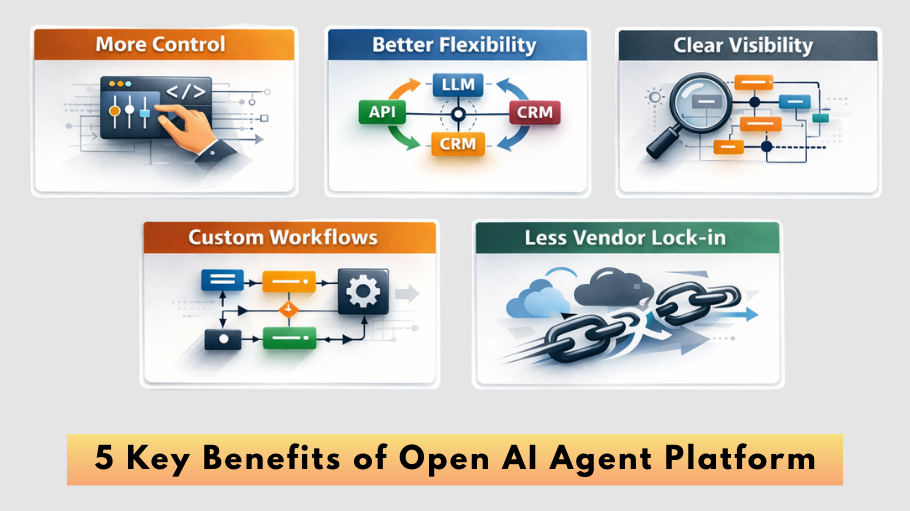
Open source AI agent platforms appeal to businesses because they offer more control where it actually matters. Teams get more room to shape the system around their own workflows, integrations, and operating needs instead of adjusting everything to fit a fixed product.
More control
Open platforms give teams more visibility into how the system works. That makes it easier to adapt the agent layer around real business processes instead of relying on a closed setup.
Better flexibility
A strong open platform makes it easier to work across models, frameworks, and systems. That flexibility matters because most businesses do not want their whole strategy tied to one vendor path.
Clear visibility
Open systems are usually easier to inspect, test, and trace. That becomes more important once businesses need to understand how an agent behaved and why it made a certain move.
Custom workflows
Open agent platforms are easier to extend when teams need custom workflows, stronger guardrails, or deeper orchestration. That makes them more practical for business environments with specific operating needs.
Less lock-in
One of the biggest benefits is having more freedom as the market changes. Open platforms make it easier to evolve the stack over time without rebuilding everything around one provider.
Common Challenges in Adopting Open Source AI Agent Platforms
Open source gives businesses more flexibility, but adoption still comes with real friction. The hard part is not getting an agent to work once. It is making the platform reliable, secure, and usable across real business systems.
- Integrations get messy when systems are disconnected.
- Poor data quality weakens agent performance fast.
- Governance gets harder once agents act across workflows.
- Security risk rises when agents access tools and data.
- Low visibility makes failures harder to trace.
- Deployment takes more effort in enterprise environments.
- Open source needs stronger in-house capabilities to manage well.
The Future of Open AI Agent Platforms
I do not believe that the future will be determined by the most vocal AI agent platform. The future will belong to platforms that enable users to manage their agents, customize them, and develop confidence in their performance throughout actual business operations. The reason open source matters in this situation is that it enables organizations to develop their own operational systems.
The market is moving toward agent infrastructure, which allows businesses to build their systems according to their specific requirements instead of relying on preconfigured solutions from vendors. The actual transformation involves organizations implementing additional agents while creating structured and adaptable systems for operational usage.
Are you exploring how AI agents can actually work inside your business operations? Let’s connect and discuss how this can fit your use case.
