
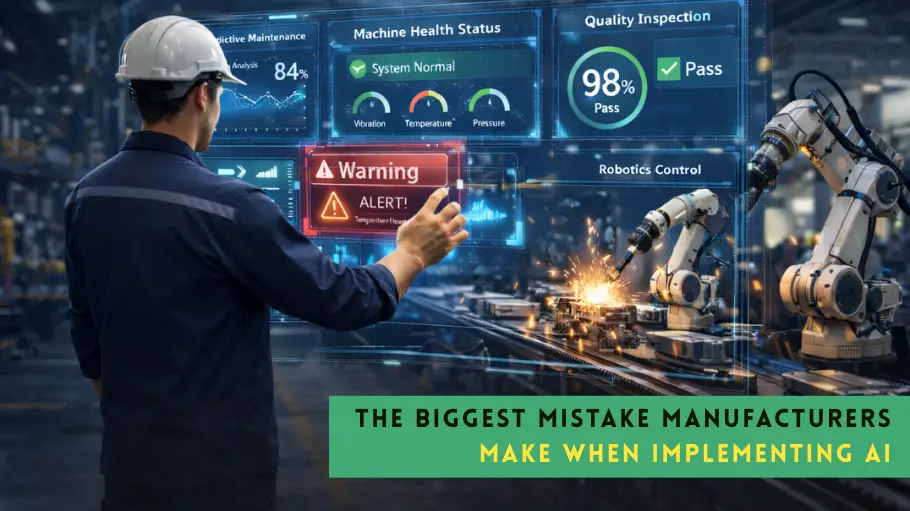
The biggest mistake manufacturers make with AI is treating it like another tool to plug in. A dashboard gets added, alerts start showing up, and it looks like progress. But the actual workflow on the floor stays the same.
That is where most of the value gets lost. If operators still need to double-check everything and supervisors still fall back on manual decisions, AI is not really improving operations. It is just sitting beside the work instead of moving it forward.
A recent Deloitte 2026 report captures this well: 66% of leaders say designing human-AI interaction matters to business success, but only 6% say they are leading in it. That gap is exactly what shows up in manufacturing, too. The tool gets deployed, but the workflow never changes enough for the impact to show.
Why AI Pilots in Manufacturing Struggle in Real Production
AI pilots in manufacturing usually look strong in the beginning because they are tested in controlled conditions. The data is cleaner, the scope is tighter, and the environment is far more predictable than a real plant. But once that same system reaches the floor, it has to deal with production pressure, shifting conditions, operator workarounds, and all the small exceptions that never show up in a demo.
A few things usually go wrong very quickly:
- The pilot works on ideal data, but struggles with real plant-floor variation.
- Operators do not trust the output enough to rely on it during live production.
- The AI sits outside the daily workflow, so teams keep going back to manual decisions.
- One or two wrong calls are enough to kill confidence.
That is why so many pilots never turn into real operational systems. BCG’s global AI study found that only 5% of companies are achieving AI value at scale, while 60% are still seeing little or no material value. In manufacturing, that gap makes perfect sense. It is not that the pilot looked bad. It is that the plant floor is always tougher than the pilot environment.
7 Reasons AI in Manufacturing Fails to Deliver Real Business Value
Most AI projects in manufacturing face operational difficulties because their technology fails to perform as expected. The actual manufacturing environment proves more challenging than anticipated for their operational requirements. The pilot project demonstrates initial success but is later constrained by production requirements, existing systems, operator performance, and daily operational demands. The explanation for this occurrence is found through seven distinct reasons.
1. The use case does not solve a real plant problem
The proposal may seem impressive, but it lacks any connection to the plant’s actual daily operations. The value of a project decreases for people once it fails to deliver improvements in downtime, quality, throughput, yield, and cost.
2. The data is not good enough
A lot of manufacturers assume that having data is enough. It is not. If the data is incomplete, inconsistent, or delayed, the AI output becomes harder to trust in real production.
3. The AI is not built into the workflow
At this stage, many projects begin to lose traction. The operators will return to using their existing method when they need to stop working to access AI through a different system, which requires them to follow additional procedures.
4. The floor does not trust the output
In manufacturing, trust matters fast. If the system gets a few calls wrong or misses something important, people go right back to manual decisions and stop relying on it.
5. The pilot was too controlled
Most pilots are built in a clean environment with narrow conditions. Real plants are not like that. They are full of variation, exceptions, pressure, and small issues that change how the system performs.
6. No one owns the result
AI projects often get shared across too many teams. Everyone supports it, but no one is fully responsible for making sure it improves a real business number on the floor.
7. Old systems slow everything down
Many plants are still working with disconnected machines, legacy software, and siloed systems. That makes it much harder for AI to work smoothly across operations and deliver real value.
Top AI Use Cases in Manufacturing Driving Measurable Results
In manufacturing, operations gain the most value from AI implementations when they address standard plant challenges rather than when they demonstrate advanced capabilities. The system delivers four benefits: it helps organizations reduce downtime, enhance product quality, accelerate decision-making, and establish consistent operational procedures.
- Predictive maintenance that helps teams catch equipment issues before they turn into unplanned downtime.
- Visual quality inspection that spots defects faster and more consistently than manual checks alone.
- Production monitoring that flags anomalies early, before they affect output or quality.
- Scheduling support that helps plants adjust faster when demand, materials, or line conditions shift.
- Energy optimization that identifies waste across machines and processes and helps lower operating costs.
- Operator support tools that help teams find answers faster and solve repeated issues with less delay.
- Robotics and physical AI for repetitive inspection, movement, and shop-floor tasks where consistency matters most.
How Physical AI Robotics and Edge Intelligence are Reshaping Modern Manufacturing Operations
In today’s manufacturing world, AI technology now operates directly on factory floors rather than remaining confined to control-room displays. The technology appears in various systems, which include robots, vision systems, sensors, and edge devices that enable real-time issue detection and decision-making support. Manufacturers dedicate their resources to inspection and anomaly detection, PPE monitoring, material movement, and equipment health use cases.
What makes this shift important is simple: on the plant floor, decisions often need to happen near the machine, not later in a report. The World Economic Forum noted in 2026 that physical AI is pushing intelligence into real-world operations, and its cited enterprise survey found 58% of organizations are already using physical AI in some form. That is why this trend matters so much in manufacturing. It is not just about improving visibility. It helps plants operate faster, more safely, and more responsively in real time.
The Importance of Explainable AI in Manufacturing Operations
In modern manufacturing, AI systems must deliver precise results that users can trust based on their understanding of the system. The system needs to present information in a clear, trustworthy way so users can operate it during live production. The team requires an explanation of system behavior when it detects a defect, suggests maintenance, or detects an operational problem. The production environment already lacks tolerance for decisions that use hidden operational methods.
That is exactly why this matters so much:
- Teams need to understand why the system made a recommendation.
- Supervisors need a clear trail they can review later.
- Operators need to trust the output before acting on it.
- Quality and safety teams need proof that decisions can be traced.
- One unreliable result can quickly push people back to manual judgment.
This gap is still very real. PwC Canada’s 2026 Trust in AI report found that 36% of organizations still do not have a dedicated AI governance function. In manufacturing, that kind of gap shows up fast. If the system cannot be explained, reviewed, and trusted, it usually does not matter how advanced it is.
Legacy Systems and IT-OT Silos: The Biggest AI Challenge in Manufacturing
A lot of manufacturers do not struggle with AI because the idea is wrong. They struggle because the plant environment is far more complex than the pilot made it seem. When AI has to work across older machines, disconnected systems, and long-standing operational workarounds, scaling becomes much harder than expected.
Old machines
Many plants still rely on equipment that was never built to support modern AI systems. That makes integration slower and far more manual than most teams expect.
Siloed systems
Important data often sits in different machines, platforms, and software tools. When those systems do not connect properly, AI cannot get the full picture.
IT and OT gap
IT teams and operations teams usually work in very different ways. If they are not aligned early, even a good AI project can get stuck.
Brownfield limits
Older plants come with years of custom fixes, manual processes, and undocumented dependencies. AI has to work around all of that, which adds friction.
Integration delays
Even when the use case is solid, progress slows down if the surrounding infrastructure is inconsistent or outdated. The model is complete, but the plant remains unprepared.
Scaling issues
This is why one pilot may work on a single line, but scaling it across sites becomes much harder. The complexity grows fast once AI has to fit into real operations.
The Role of Workforce Upskilling in AI Adoption in Manufacturing
AI success in manufacturing relies not just on equipment but on how people use it. The technology becomes operational when production staff, engineering teams, and their supervisors establish their confidence in adopting its use. The team experiences adoption difficulties because it does not understand the system components that bring operational benefits and essential value to its service.
Achieving AI success also depends on organizations building strong workforce readiness programs that help staff perform effectively. Manufacturing operations depend on dedicated personnel who maintain essential knowledge about plant operations. Companies that succeed in this area demonstrate effective procedures to honor operational expertise while providing staff members with hands-on training and implementing change management practices from their initial rollout phase.
How Leading Manufacturers are Turning AI from Pilot Projects into Production-Ready Operations
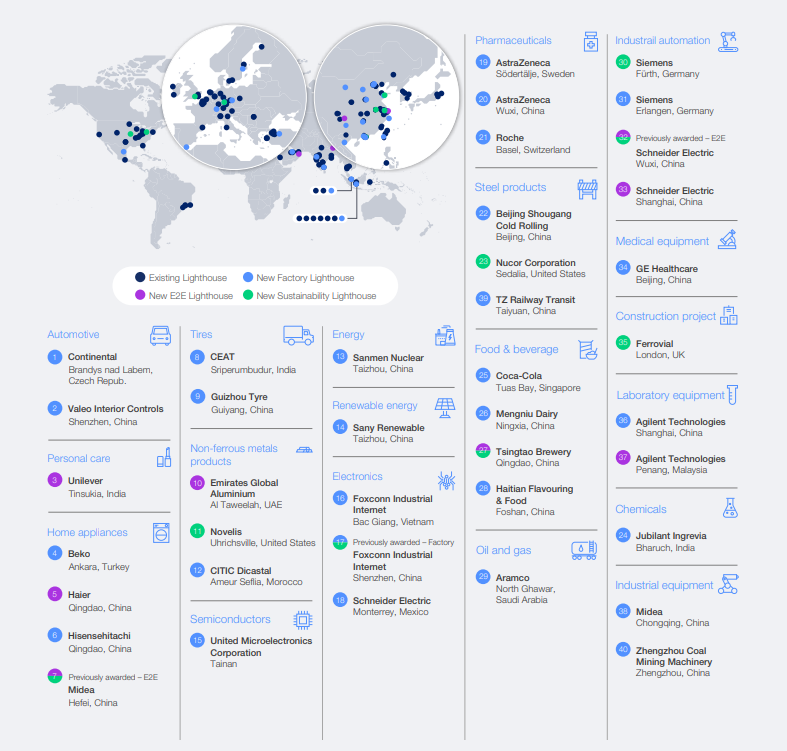
The manufacturers seeing real value from AI are not treating it like a side experiment anymore. They are building it into live operations where it can support real decisions, improve consistency, and hold up under production pressure. That is the difference between a pilot that looks good in a presentation and a system people actually rely on during a shift. As the image below from the World Economic Forum’s Global Lighthouse Network Report shows, leading manufacturers across industries are already making that shift in real production environments.
- They start with one workflow that clearly matters.
- They tie AI to quality downtime, throughput, or cost.
- They build it into the tools and processes teams already use.
- They test it in real plant conditions, not just clean pilot setups.
- They keep operators, engineers, and supervisors involved from the start.
- They scale only after it proves it can work across lines and shifts.
That is usually what separates momentum from noise. The leaders in this space are not trying to make AI look impressive. They are making it useful enough to become part of how the plant actually runs.
How to Implement AI in Manufacturing for Real Business Impact
If manufacturers want AI to create real value, the starting point is usually simpler than it seems. It is not about running more pilots or adding more tools. It is about picking one workflow that matters, building AI into it properly, and making sure it works in real plant conditions.
Begin with one workflow
Pick one process where the plan is already clear, like quality checks, downtime response, or maintenance planning. It is much easier to create impact when the problem is already obvious.
Connect it to one metric
Be clear about what needs to improve from the start. It could be scrap, throughput, downtime, yield, or cost per unit, but it has to be something the plant actually tracks.
Integrate it into daily work
AI works best when it fits into the way teams already operate. If people have to leave their normal process just to use it, adoption usually drops quickly.
Try it on the real floor
Clean pilot results are not enough. The system needs to work when conditions change, the line gets busy, and real production pressure kicks in.
Keep everyone involved
Operators, engineers, and supervisors need to stay close to the rollout. That is how the system earns trust and starts fitting into real day-to-day work.
Scale only once it works
Once one workflow is working consistently, then expand it across lines, shifts, or sites. That is usually how AI becomes part of operations instead of staying stuck as a pilot.
What I’ve Learned About AI in Manufacturing After Years of Building Real-World Systems
AI in manufacturing creates real value only when it becomes part of how the plant actually runs. As a TechnoBrains Business Solutions founder, I have seen that the difference is rarely the model itself. It is usually whether the system is built into the workflow strongly enough to help teams make better decisions, respond faster, improve quality, and keep operations moving when the pressure is real.
That is why I believe the manufacturers who win with AI will be the ones who treat it as an operational shift, not just a technology upgrade. From what I have seen as a Technobrains founder, once AI is tied to the workflow, trusted by the people using it, and connected to outcomes the plant actually cares about, it stops feeling like an experiment and starts becoming part of how modern manufacturing works.
