
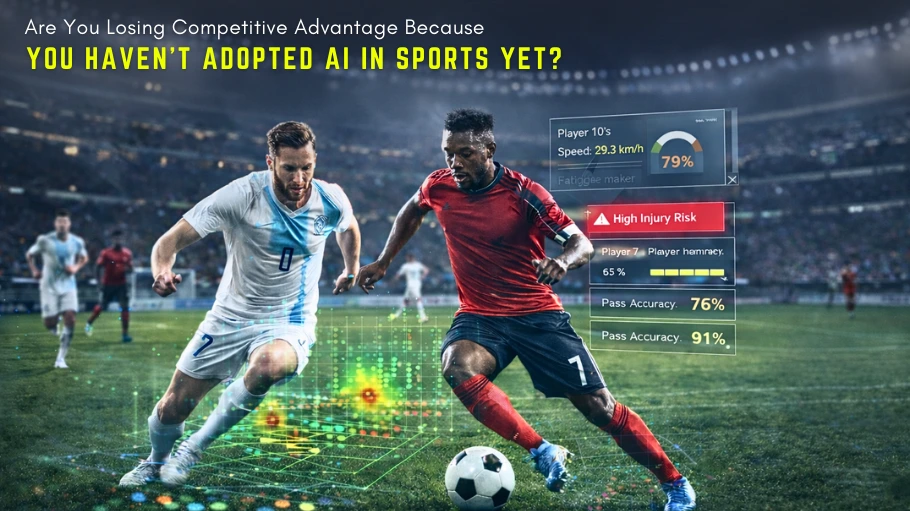
I’ve been around sports tech long enough to recognize the pattern: first, the tools look like toys, then one or two serious teams use them to win small edges, and then suddenly everyone realizes they weren’t a side project; they were the new baseline. That’s what 2026 feels like for AI in sports. It’s not just helping people analyze games faster. It’s starting to sit in the middle of decisions that used to be made on instinct, experience, and a lot of late-night video review.
What’s changed isn’t that teams “discovered AI.” It’s that AI is finally showing up where sports actually live: in messy real-world workflows. Coaches want answers during a match, not a report on Monday. Performance staff wants early warning signals, not post-injury explanations. Ops teams want fewer breakdowns on matchday, not prettier dashboards. When AI fits into those moments, it stops being technology and starts becoming infrastructure.
And the adoption signals are real, not just hype. Grand View Research estimates the global sports analytics market at about $5.68 billion in 2025, projecting strong growth from there. That size tells you something simple: teams aren’t “trying AI” anymore; they’re budgeting for it, staffing around it, and expecting it to produce outcomes.
AI Performance Analytics is Now Accessible to All Sports Teams
For years, performance analytics had a simple gate: budget. If you were an elite club, you had tracking systems, analysts, and vendors turning every match into structured insight. If you weren’t, you relied on coaches’ eyes, basic stats, and a lot of manual video work. In 2026, that gap is shrinking fast because the expensive parts are getting compressed. Today, standard match footage and training clips can be turned into usable signals without a massive hardware setup, and that’s changing who gets to play the “data game.”
What matters now is not who collects the most data. It’s who can turn everyday inputs into repeatable decisions. The teams pulling ahead are building a simple rhythm: review patterns, spot what’s breaking, adjust training, test it in matches, and keep refining. Once that loop becomes weekly and lightweight, analytics stops being a department and becomes part of the coaching culture.
Key takeaways
- Performance analytics is becoming accessible to clubs beyond the top tier.
- Regular video is turning into usable performance insight, not just film study.
- The advantage is shifting from having data to using it consistently.
- Teams that build a weekly insight-to-action loop will outpace teams that treat analytics as occasional.
How AI Video Analysis is Changing Coaching Decisions
If you’ve been in a coaching room for a few seasons, you know the real constraint isn’t “we don’t have footage.” It’s that nobody has time to turn footage into decisions fast enough to matter. That’s why video intelligence is having its moment. It’s taking match and training video and doing the boring work humans hate doing at scale, tagging, filtering, clustering patterns, and surfacing the clips that actually change what you do on Tuesday.
What makes 2026 feel like the tipping point is that this is moving beyond performance teams and into live decision workflows. A simple proof of where the industry is heading is what’s happening in officiating and broadcast-grade tracking. Reuters reported the NFL is rolling out Sony’s Hawk Eye virtual measurement system using six 8K cameras, cutting first down measurement time by up to 40 seconds versus manual chains. That’s not just a tech upgrade. It’s the same story coaches care about: computer vision turning video into real-time, trusted decisions.
Key takeaways
- Video is shifting from “review later” to “decide now,” because AI can surface patterns and moments at speed.
- The best tools are the ones that fit coaching habits, clips, sequences, comparisons, not dashboards.
- Once video insight becomes fast and reliable, the edge moves to teams that act on it weekly, not teams that just collect it.
How Wearables and AI are Improving Player Performance and Injury Prevention
When wearables stay in training, they’re mostly a performance nice-to-have. The moment leagues allow them in official games, they become something else entirely: a live decision input. Because now the data is arriving at the exact moment you’re making calls on substitutions, minutes, tempo, and risk. If you’ve ever watched a player “look fine” and then pull up two minutes later, you already understand why this matters. Wearables don’t replace coaching judgment, but they do reduce the number of decisions made blindly.
The tricky part is that in-game wearables are not just a tech rollout. They turn into a governance rollout. Biometric data is sensitive, interpretations can be wrong, and incentives don’t always align between club, player, and league. So the teams that benefit most won’t be the ones who collect the most metrics. They’ll be the ones who define clean rules early: what’s measured, who can see it, how it’s stored, and what decisions it’s allowed to influence in real time.
FIFA’s guidance around Electronic Performance and Tracking Systems is a useful reference because it treats tracking as something that must be validated for reliability and accuracy, not just “installed and used.”
Sports Wearables Market Key Takeaways
- In-game approval changes wearables from “monitoring” to “decision support.”
- The real value is catching overload and fatigue before it becomes an injury problem.
- Governance becomes unavoidable: consent, access, storage, and misuse risk.
- The edge goes to teams that operationalize wearables into weekly routines, not teams that treat them like gadgets.
How AI Copilots Help Coaches and Analysts Make Faster Decisions
- Most teams don’t have a data problem. They have a time problem.
- Copilots help because you can just ask, “What broke in our press after 60 minutes?” and get the clips and patterns back fast.
- This isn’t niche anymore. Reuters says the Premier League is working on Microsoft Copilot are using 30+ seasons of data, about 300,000 articles, and 9,000 videos.
- The big win is speed. You get answers during prep or right after training, not a week later in a report.
- It also helps lean teams. One analyst can support more coaches because the first draft of insight is automated.
- If it can’t show “why” with receipts like clips, timestamps, and sources, people stop trusting it fast.
How AI is Improving Stadium Operations and Matchday Management
If you’ve ever been responsible for a matchday, you know the stadium doesn’t “run.” It gets held together by a hundred small decisions happening at once. One gate gets crowded, a line builds near one food stall, a section runs out of water, a restroom area turns messy, a lift stops working, and suddenly everyone is reacting instead of managing. That’s exactly why AI is moving into stadium operations. Not because it’s trendy, but because it helps teams stay ahead of problems before fans feel them.
What’s different now is the timing. Stadium tech used to tell you what went wrong after the game. Now it’s starting to tell you what’s about to go wrong while you still have time to fix it. The goal isn’t “more data.” The goal is fewer headaches. When you can spot crowd build-up early, shift staff in minutes, and restock the right places before halftime hits, the whole day feels smoother, and the fan experience quietly improves.
Here’s the simple operator playbook I use when thinking about AI in venues:
- Use it to keep entry and movement smooth, so queues don’t take over the day.
- Move staff based on what’s happening live, not what the plan guessed.
- Catch maintenance issues early, before they turn into a public problem.
- Restock based on real demand, not gut feel.
- Make sure every alert comes with a clear reason, or your team will ignore it under pressure.
How AI is Transforming Sports Business Operations
Most people talk about AI in sports as if it’s only a coaching tool. In reality, the bigger shift is happening off the pitch. Clubs are asset-heavy businesses with tight margins and high expectations. Stadium uptime, facility maintenance, staffing, ticketing, merch, security, and fan service all have to work every single matchday. That’s why sports orgs are starting to adopt the same “industrial AI” mindset you see in manufacturing: prevent issues early, run operations more smoothly, and make decisions from one connected view of the business.
One quick indicator of where this is going: Mordor Intelligence estimates the sports management software market at $11.33B in 2026, up from $10.2B in 2025.
What this looks like in practice is pretty straightforward. Clubs are starting to treat stadiums and facilities like mission-critical assets, push toward fewer disconnected tools and more unified data, automate the boring but high-impact workflows like maintenance and staffing, and measure success by fewer matchday surprises instead of nicer reporting.
How AI is Personalizing the Sports Fan Experience
If you want the clearest signal of where sports are going, don’t look at training. Look at the living room. Fans are used to Netflix, YouTube, and TikTok feeds that feel personal by default, and they’re starting to expect the same from sports.
In 2026, the live game is still the product, but the layer around it is getting personalized: the highlights you’re served, the angles you’re shown, the stats you see, and even the moments when merch or ticket offers appear.
What most teams underestimate is that personalization isn’t just “nice UX.” It’s a lever for retention and revenue, especially when attention is fragmented across platforms and subscriptions. IBM’s study captures the shift in expectations well: fans’ top AI-driven priorities include real-time game updates (35%) and personalized content (30%).
How AI is Connecting Sports Broadcasting and Real-Time Betting
Betting isn’t sitting on a second screen anymore. In 2026, it’s getting pulled into the broadcast itself through live prompts, quick predictions, and in-play moments that update instantly as the game shifts. The key reason is simple: online betting makes this easy to sync in real time, which is exactly what your Grand View Research segmentation visual shows with Platform Outlook: Online vs Offline.
Once betting is online, it naturally becomes “broadcast-native,” but that also means leagues and platforms have to take integrity and responsible use more seriously, because real-time betting can amplify mistakes and manipulation just as fast as it boosts engagement.
Why Trust and Data Integrity are Critical in AI-Powered Sports
- The more AI gets involved in sports, the more everything depends on one thing: people believing what they’re seeing. If trust breaks, fans tune out, sponsors get nervous, and the whole content engine gets noisy.
- The scary part is how easy it is now to manufacture “breaking news.” Reuters described cases where thousands of people believed fabricated posts and quotes attributed to star players, even though they were completely fake.
- Fake content doesn’t just damage reputations. It draws attention to unofficial pages, messes with engagement, and can siphon value away from legitimate sports media.
- Betting raises the stakes. When narratives move fast, even a small wave of fake updates can influence how people react in real time.
- The fix isn’t fancy. Teams need always-on monitoring, clear “official channel” habits, and a response playbook that’s ready before the next fake story hits.
- In 2026, the best-run orgs won’t just be the most AI-enabled. They’ll be the most verifiable.
Why AI Adoption Will Define Winning Sports Organizations
After a decade of building and shipping AI into real operations, here’s what I believe is true about sports in 2026: the edge isn’t “using AI.” The edge is turning AI into a habit. The teams and leagues that pull away will be the ones that make AI boring and repeatable, built into weekly prep, matchday operations, and fan touchpoints without drama, without heroics, without constant reinvention.
The second truth is that trust is now a performance metric. Not just on the pitch, but across the entire system. If your data isn’t clean, your outputs aren’t verifiable, and your channels aren’t protected, the tech will create noise faster than it creates advantage. The winners won’t be the loudest adopters. They’ll be the most disciplined operators, the ones who can move fast while still producing receipts.
And finally, sports are still the best stress test for AI because it’s live, emotional, and public. Every mistake is visible. Every win is measurable. That’s why what works in sports tends to travel. If you can run AI in an environment where decisions are real-time and stakes are high, you can run it anywhere.
